A Short History of Sunderland
From Bede and the Wearmouth monastery to shipbuilding, Nissan, city status and Riverside Sunderland: thirteen centuries of history on the Wear, and where to see it today.
Sunderland grew up where the River Wear meets the North Sea, and almost every chapter of its story is tied to that river. A monastery on its north bank made Wearmouth one of the most important places of learning in early medieval Europe. Later the river carried salt, coal and glass, and for more than six centuries ships were built along its banks. This guide follows that story from the seventh century to the present, with pointers to the places where you can still see it.
Bede and the Wearmouth monastery
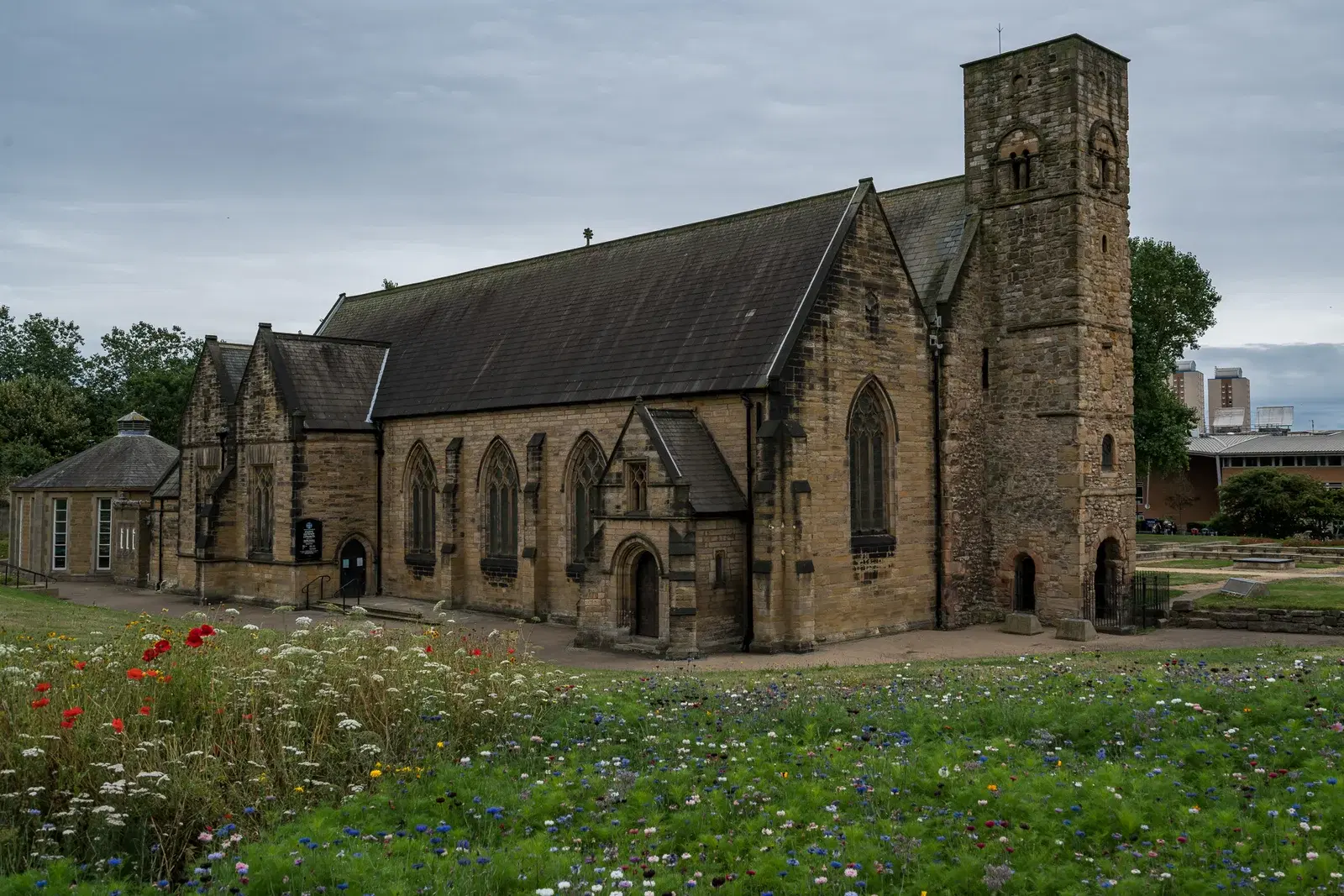
In 674 Benedict Biscop, a Northumbrian nobleman who had travelled to Rome, was granted land on the north bank of the Wear by King Ecgfrith. There he founded the monastery of St Peter, which together with St Paul's at Jarrow formed the twin monastery of Wearmouth-Jarrow. Biscop brought masons and glaziers from Gaul to build in stone and glass, and he filled the library with books gathered on his journeys.
The monk and scholar Bede was born on the monastery's lands in 673 and entered it as a child. He completed his Ecclesiastical History of the English People in 731. St Peter's Church in Monkwearmouth still stands, and the west wall and porch of the original church survive. In 2004 the city adopted Benedict Biscop as its patron saint.
The medieval port and Bishopwearmouth
For centuries the area was three separate places: Monkwearmouth on the north bank, the large parish of Bishopwearmouth on the south bank, and a small riverside settlement called Sunderland, the "sundered land" cut off by the river. Around 1179 Hugh Pudsey, Bishop of Durham, granted a charter to the borough under the name Wearmouth, encouraging trade at the river mouth.
Inland, Sir William Hylton built a fortified gatehouse-tower around 1400. Hylton Castle still stands at Castletown, with the Hylton arms and the white hart badge of Richard II carved over the entrance. To the west, the family who took their name from Washington lived at what is now Washington Old Hall, the ancestral home of George Washington's family.
Best for: Hylton Castle and Washington Old Hall suit anyone who wants to see medieval Wearside in stone rather than on a page.
Salt, coal and glass
By 1589 salt was being produced by boiling seawater in pans along the shore, and coal soon followed as the town's main export. Shipments grew from a few thousand tons a year in 1600 to around 180,000 tons by 1680, carried down the river in keel boats and loaded onto colliers bound for London.
Glassmaking arrived in the 1690s and became a lasting part of the town's identity, joined later by pottery such as Sunderland lustreware. The National Glass Centre beside St Peter's Church closed permanently on 31 July 2026. Sunderland's glass and pottery collections are held by Sunderland Museum and Winter Gardens, which closed at the end of August 2026 for a £13.6 million redevelopment and is due to reopen in late 2028 with new galleries on the city's heritage.
Shipbuilding on the Wear
Ships were first recorded being built at Wearmouth in 1346. Over the following centuries the yards multiplied along both banks, and by the nineteenth century shipbuilding was the town's defining industry, employing thousands and producing vessels that sailed all over the world.
Decline set in during the second half of the twentieth century, and the last shipyard on the Wear closed in 1988. Coal mining in the area ended in 1993.
Bridges and water
In 1796 the first Wearmouth Bridge opened, a cast-iron arch promoted by Rowland Burdon that was among the earliest iron bridges in the world. It was replaced by the present steel arch bridge, built by Sir William Arrol and Co and opened on 31 October 1929. The neighbouring Wearmouth railway bridge followed in 1879.
The growing town needed clean water, and in 1868 a pumping station was built at Ryhope. Its two beam engines ran until 1967 and are still kept in steam by volunteers at the Ryhope Engines Museum.
Best for: Ryhope Engines Museum suits families and anyone curious about Victorian engineering, especially on a steam day.
The Victorian town
Sunderland expanded quickly in the nineteenth century. Mowbray Park became the town's principal public park, and in 1879 Sunderland Museum moved into a new building beside it. The museum had been founded in 1846 as the first municipally funded museum in the country outside London. In the East End, the Donnison School, built in 1798 to educate poor girls of the parish, survives as a heritage centre on Church Walk.
The Sunderland Empire opened on 1 July 1907, launched by the music hall star Vesta Tilley, and it remains the city's main theatre. The Sunderland Antiquarian Society, founded in 1900, still collects and shares the town's records from its centre on Douro Terrace.
Best for: The Donnison School and the Antiquarian Society suit local and family historians who want to dig into the East End and beyond.
The twentieth century
The town paid a heavy price in both world wars. A Zeppelin raid on Monkwearmouth in 1916 killed 22 people, and air raids during the Second World War killed 267. After 1945 the shipyards and pits remained the main employers until their decline in the 1970s and 1980s.
A new chapter began in 1986, when Nissan opened its car plant near Washington. In 1992 Sunderland was granted city status, and in the same year Sunderland Polytechnic, which began as Sunderland Technical College in 1901, became the University of Sunderland. The Stadium of Light opened in 1997 on the site of the former Wearmouth Colliery.
Riverside Sunderland
The Vaux brewery closed in 1999, leaving a large site above the river in the city centre. It is now the core of Riverside Sunderland, a long-term plan for offices, homes and public space on both banks. City Hall opened on the former Vaux site in November 2021, and the Keel Crossing footbridge, linking Keel Square to the Sheepfolds area near the Stadium of Light, opened permanently on 18 October 2025.
Seeing the history today
Beyond the city centre, Penshaw Monument, built in 1844 to 1845 in memory of the 1st Earl of Durham, looks out over the whole of Wearside. Fulwell Mill, a restored windmill on Newcastle Road, opens on selected days, so check before you go.
Best for: Penshaw Monument suits walkers and anyone who wants a view across the whole city and its history.
Know a place we have missed? Get in touch.
Local businesses mentioned
Hylton Castle
Craigavon Road, Castletown, Sunderland, SR5 3PA
Washington Old Hall
The Avenue, Washington Village, Washington, NE38 7LE
Penshaw Monument
Chester Road, Penshaw, Sunderland, DH4 7NJ
Ryhope Engines Museum
Waterworks Road, Ryhope, Sunderland, SR2 0ND
Donnison School Heritage and Education Centre
Church Walk, East End, Sunderland, SR1 2BJ
Sunderland Antiquarian Society Heritage Centre
6 Douro Terrace, Sunderland, SR2 7DX
Never miss what’s on
Join the weekly SunderlandCity.live digest — the best events, news and local tips, straight to your inbox. One email a week.
What's On
Witches, Fairies and Satan: Folk Tales of County Durham
1:00 PM · Arts Centre Washington, Biddick Lane, Fatfield, Washington, NE38 8AB
Frozen Assets
7:30 PM · Arts Centre Washington, Biddick Lane, Fatfield, Washington, NE38 8AB
Spotlight: Washington Open Exhibition 2026
See website · Arts Centre Washington, Biddick Lane, Fatfield, Washington, NE38 8AB