The History of the Sunderland Empire Theatre
From Vesta Tilley's opening night in 1907 to Tommy Steele, the Beatles, Sid James and today's touring musicals: the story of the Sunderland Empire on High Street West.
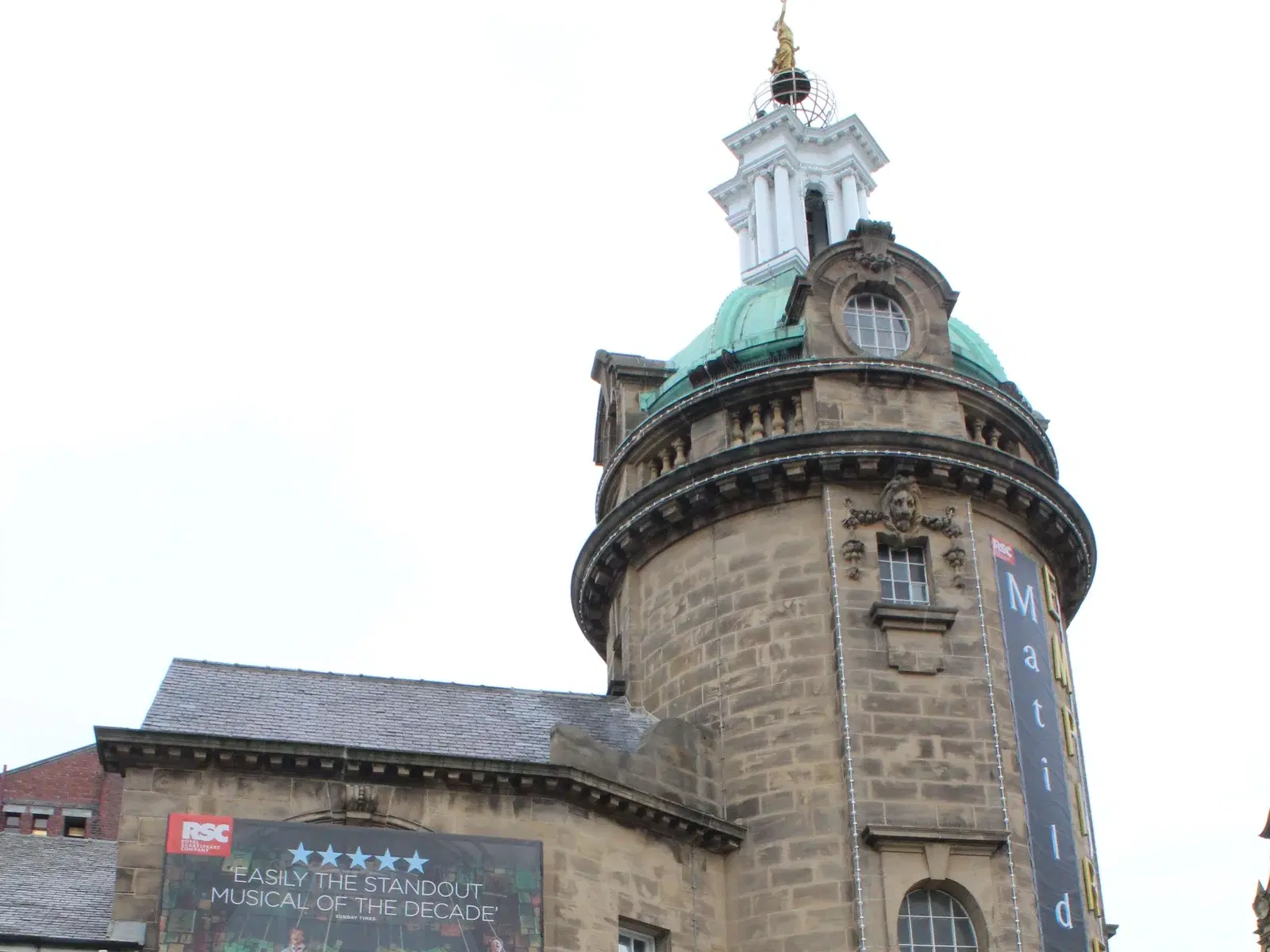
With its copper dome and corner tower, the Sunderland Empire is one of the most recognisable buildings in the city centre. It has been a music hall, a variety theatre, a cinema of sorts and, for the last few decades, the North East's main stop for large touring musicals. This guide follows its story from 1907 to the present day.
Building the Empire Palace
The theatre was established by Richard Thornton and designed by the architects W. and T. R. Milburn. The foundation stone was laid on 29 September 1906 by Vesta Tilley, one of the best-known music-hall performers of her day, and a plaque on the building still records the occasion. She returned to open the Empire Palace on 1 July 1907.
The building is in a style usually described as Free Baroque. It has a stone entrance on High Street West, a copper dome and a corner tower with paired Ionic columns. Originally the tower rose about 90 feet and carried a revolving globe topped by a statue of Terpsichore, the Greek muse of dance. Both were taken down during the Second World War after a bomb fell nearby. The original statue now stands at the top of the main staircase, and a replica has since been placed back on the dome.
The music-hall years
For its first decades the Empire was a variety house. A projection box was added in 1930 so that films could also be shown.
The Empire gained a reputation among comedians as a "comic graveyard", a hard house where audiences did not laugh easily. It also gave some performers their start. Tommy Steele made his stage debut here on 5 November 1956, and Helen Mirren made her first stage appearance at the Empire.
Closure and the council rescue
The Empire closed in May 1959. Rather than lose it, Sunderland Council bought the building, and it reopened in 1960. The council still owns it today.
The Beatles played here in November 1963. The theatre also hosted University of Sunderland graduation ceremonies until 2004.
Sid James and the ghost stories
The best-known event in the Empire's history is a sad one. On 26 April 1976 the comic actor Sid James, star of the Carry On films, suffered a heart attack on stage during a performance of the farce The Mating Season, and died on the way to hospital.
Over the years the Empire has collected a number of ghost stories, several of them linked to Sid James, Vesta Tilley and a woman called Molly Moselle, who disappeared in 1949. The comedian Les Dawson is said to have refused to play the theatre again. These are stories rather than history, but they are part of the theatre's folklore.
Listed status and the 2004 rebuild
The Empire was listed Grade II* in 1978. The listing describes a remarkably unaltered interior: a circular entrance lobby with painted classical scenes and a terrazzo floor, and boxes set into round turrets. Inside there are four levels of seating: the stalls, Dress Circle, Upper Circle and Gallery, with about 1,860 seats in all.
The biggest change in its history came in 2004, when the theatre closed for nine months for a multi-million-pound redevelopment. The stage and fly tower were enlarged so that the largest touring productions could fit. The Empire reopened on 9 December 2004 with Starlight Express.
That work explains the theatre's programme today. Large productions such as Wicked, Matilda, War Horse and Miss Saigon have played Sunderland rather than other North East theatres because of the size of the stage. Birmingham Royal Ballet treats the Empire as its North East base.
The theatre marked its centenary in 2007, when Mickey Rooney appeared in that year's pantomime, Cinderella.
Who runs it now
The building is owned by the council and operated by Ambassador Theatre Group on behalf of the Sunderland Empire Theatre Trust. The programme mixes touring musicals and plays with comedy, concerts and the family pantomime each winter. The history of Sunderland High Street explains how this end of town became the city's entertainment quarter.
Best for: The Empire runs public venue tours on selected Saturdays, a chance to see more of the building than you would on a show night. Check the ATG website for dates.
See it today
The Empire is at 4-5 High Street West, SR1 3EX, a short walk from Sunderland station and Park Lane Interchange. Even if you are not seeing a show, the dome, tower and foundation stone plaque can all be seen from the street.
At the time of writing, Billy Elliot the Musical runs until 28 November 2026, with public venue tours on Saturdays from 14 November to 5 December. This year's pantomime, The Further Adventures of Peter Pan: The Return of Captain Hook, runs from 11 December 2026 to 3 January 2027, including a relaxed performance on 28 December. Early 2027 brings Six, Annie, CATS, The Curious Incident of the Dog in the Night-Time, Everybody's Talking About Jamie and Singin' in the Rain, alongside stand-up from Joanne McNally in January. More than a century after Vesta Tilley opened it, the Empire is still putting on big nights out on High Street West.
Next door, The Dun Cow is a Grade II listed Edwardian pub, and the Fire Station nearby runs its own programme of gigs and theatre. Culture House on Keel Square is a few minutes' walk away. For a wider look at the city's live music, read our guide to Sunderland's music scene, and for an evening out see date night in Sunderland.
Have a memory of the Empire to share? Get in touch.
Never miss what’s on
Join the weekly SunderlandCity.live digest — the best events, news and local tips, straight to your inbox. One email a week.
What's On
Witches, Fairies and Satan: Folk Tales of County Durham
1:00 PM · Arts Centre Washington, Biddick Lane, Fatfield, Washington, NE38 8AB
Frozen Assets
7:30 PM · Arts Centre Washington, Biddick Lane, Fatfield, Washington, NE38 8AB
Spotlight: Washington Open Exhibition 2026
See website · Arts Centre Washington, Biddick Lane, Fatfield, Washington, NE38 8AB