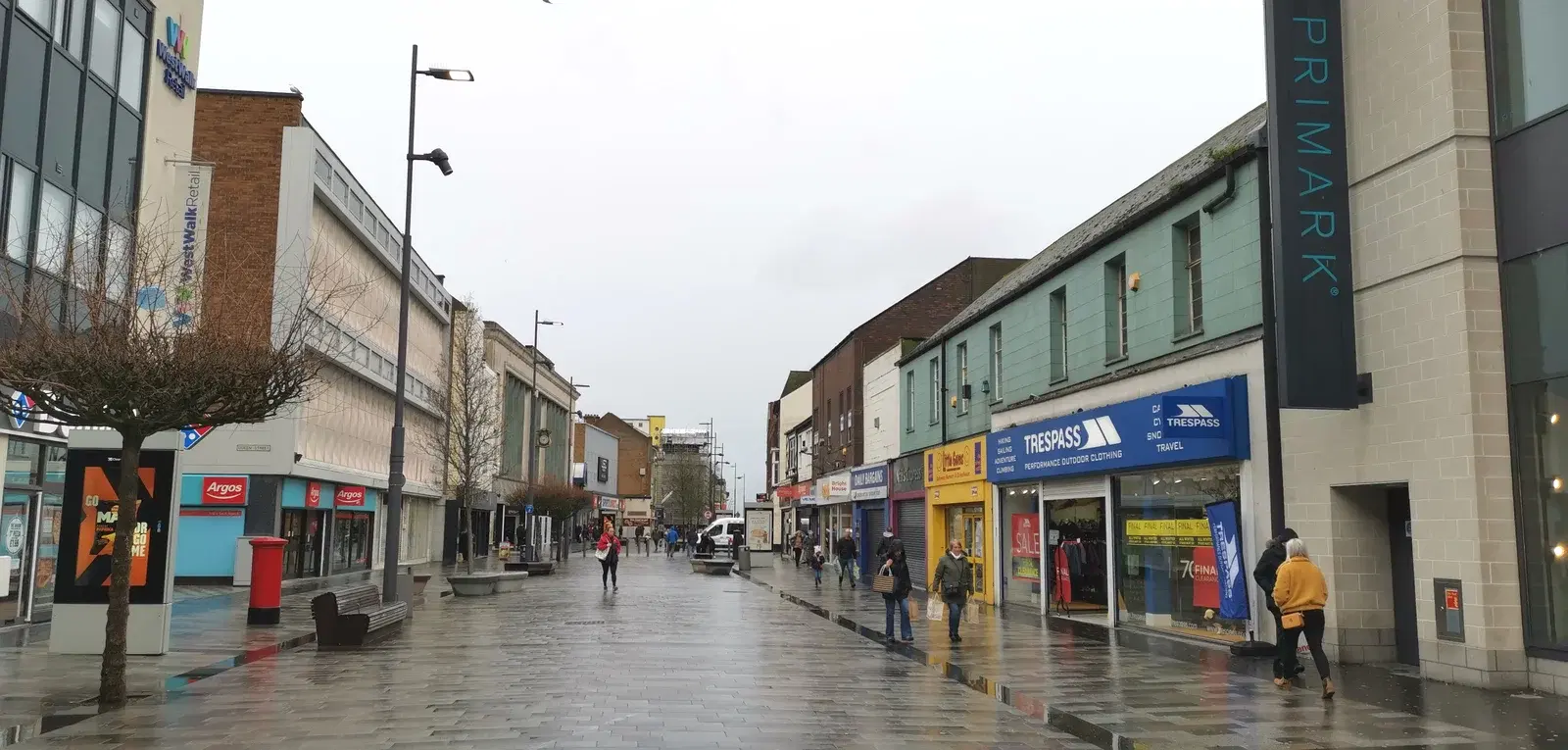
A History of Sunderland's High Street: From the East End to Fawcett Street
How Sunderland's shopping streets grew from the old East End along High Street to Fawcett Street, with the stories of Binns, Joplings, the trams, the Empire and the city centre's recent changes.
Sunderland's city centre has moved more than once. The town began at the river mouth in what is now the East End, spread west along a single long street, and later shifted its weight onto the grid of the Fawcett Estate. Walking from Holy Trinity Church to Keel Square today takes you through all of these stages, past Edwardian pubs, the Empire Theatre and the sites of department stores that once defined a day out in town. This guide traces that story and points to what you can still see. For the wider background, read our history of Sunderland.
The old town in the East End
The first Sunderland was a small port on the south bank of the Wear. In 1719 it became a parish of its own with the opening of Holy Trinity Church, and by 1720 the area around the church was fully built up with merchants' houses, workshops and labourers' homes. Holy Trinity closed as a parish church in 1988 and is now cared for by the Churches Conservation Trust, which runs it as an arts and community venue under the name Seventeen Nineteen.
Close by, the Donnison School Heritage Centre on Church Walk occupies a girls' charity school built in 1798 and tells the story of the school and the East End. Opening is tied to its events and open days, so check before visiting.
Best for: Suits anyone who wants to see where Sunderland began, on foot from the city centre.
One long street
Sunderland's growth followed a single line. High Street ran west from the old port, and by 1770 the town had spread along it far enough to join up with the separate village of Bishopwearmouth. That is why the street is still divided into High Street East and High Street West, and why so much of the city's commercial history sits on one road.
When the first Wearmouth Bridge opened in 1796, the route north across the river joined the street at its western end, and Bridge Street became a busy link between the two banks.
The Fawcett Estate and a new centre
In the 19th century the town's centre of gravity moved south of High Street. The residential terraces of the Fawcett Estate gradually filled with banks, offices and shops, and Fawcett Street became the civic and commercial heart of the town.
The railway reinforced this. A passenger terminus opened on Fawcett Street in 1853, and when the line was carried over the river on a new bridge in 1879, the present Sunderland station replaced it. In 1886-90 a new Town Hall by the architect Brightwen Binyon was built on Fawcett Street, just east of the station. The council later moved to a Civic Centre opened in 1970, and in 2021 to the current City Hall on the former Vaux brewery site.
Binns and Joplings
Two department stores shaped shopping in Sunderland for well over a century.
Binns began with George Binns, a draper who opened a business in the town in 1807. The firm took premises at 38-39 Fawcett Street in 1884 and grew until it traded from both sides of the street. The store was badly damaged in an air raid in 1941, was rebuilt from 1949 and reopened in 1953, the same year it became part of House of Fraser. The Sunderland store closed in 1993.
Joplings was founded by James Jopling in 1804. Its store on High Street West burned down on 13 December 1954, and a new building on John Street opened in 1956. Joplings closed on 19 June 2010, and the John Street building has since been converted into student accommodation called Jopling House.
Trams along Fawcett Street
Horse-drawn trams arrived in 1879, and electric trams began running on 15 August 1900, first between Roker and Christ Church. Routes ran along Bridge Street and Fawcett Street into the heart of town. The last trams ran on 1 October 1954, with a farewell procession from the Town Hall to Seaburn. Sunderland tram car 16 survives and can be seen at Beamish Museum.
Theatre and pubs on High Street West
The western end of High Street became the town's entertainment quarter. The Sunderland Empire opened on 1 July 1907, with the music-hall star Vesta Tilley performing on the first night. It seats 1,860 and still hosts touring musicals and pantomime.
Next door, The Dun Cow is a Grade II listed Edwardian pub built in 1901-02 with a restored interior. A little further along, The Peacock is another listed Edwardian pub, and on Silksworth Row the Museum Vaults dates from about 1867. Opposite the Empire, the former Central Fire Station has become The Fire Station, a music and performance venue with a new auditorium that opened in 2021. For more pubs, see our best pubs in Sunderland guide.
Best for: Suits an evening out with a show and a drink in historic surroundings.
Sunniside
The streets east of Fawcett Street are known as Sunniside. Regeneration started there in 2004, with Sunniside Gardens landscaped as a public space and new cafes, bars and restaurants opening in the surrounding terraces. On High Street West in Sunniside, Pop Recs runs as a community interest company with a cafe, gigs and exhibitions.
Best for: Suits a weekday coffee and a wander around the older terraces.
The late 20th century and today
The Bridges shopping centre was extended in 2000 towards Crowtree Road and the former central bus station, drawing national chains into an indoor mall. The Park Lane bus and Metro interchange opened in 1999. The City Library on Fawcett Street closed in January 2017.
The biggest change of recent years has been on the north-west edge of the centre. The Vaux brewery, a major employer for over a century, closed in July 1999. Keel Square, a public space marking the city's maritime history, was completed in 2015, and new offices and City Hall have followed on the brewery site. Keel Tavern on Keel Square is a convenient stop at the end of a walk.
Best for: Suits visitors who want to see how the city centre is changing, ideally on a dry afternoon.
A walking route
Start at Holy Trinity in the East End, follow High Street East and High Street West past the Empire and The Dun Cow, turn into Fawcett Street to see the Victorian bank buildings, then finish at Keel Square. Our getting around Sunderland without a car guide covers buses and the Metro, and the heritage hub has more history guides.
Know a place we have missed? Get in touch.
Local businesses mentioned
Sunderland Empire
4-5 High Street West, Sunderland, SR1 3EX
The Dun Cow
9 High Street West, Sunderland, SR1 3HA
The Peacock
287 High Street West, Sunderland, SR1 3ES
The Fire Station
High Street West, Sunderland, SR1 3HA
Museum Vaults
33 Silksworth Row, Sunderland, SR1 3QJ
Donnison School Heritage and Education Centre
Church Walk, East End, Sunderland, SR1 2BJ
Pop Recs
172-175 High Street West, Sunniside, Sunderland, SR1 1UP
Keel Tavern
Unit 2, Holiday Inn, Keel Square, Sunderland, SR1 3DS
Never miss what’s on
Join the weekly SunderlandCity.live digest — the best events, news and local tips, straight to your inbox. One email a week.
What's On
Witches, Fairies and Satan: Folk Tales of County Durham
1:00 PM · Arts Centre Washington, Biddick Lane, Fatfield, Washington, NE38 8AB
Frozen Assets
7:30 PM · Arts Centre Washington, Biddick Lane, Fatfield, Washington, NE38 8AB
Spotlight: Washington Open Exhibition 2026
See website · Arts Centre Washington, Biddick Lane, Fatfield, Washington, NE38 8AB