Sunderland's Oldest Pubs: Historic Inns Still Pouring Today
Nine historic Sunderland pubs still trading in 2026, from the Grade II* tiled rooms of the Mountain Daisy to riverside Deptford locals and the Edwardian bars of High Street West.
Sunderland's pubs grew up with its industries. Keelmen, shipwrights, glassmakers and pitmen all needed somewhere to drink, and by the late Victorian period there was a pub on almost every corner of Deptford, Millfield and the old town. Many have gone, but a good number of historic pubs are still trading, several of them with listed interiors that rank among the best in the North East. This guide picks out nine that were open in 2026, grouped so you can walk between them. Dates come from Historic England listings and CAMRA's pub heritage records, and where a pub's age is uncertain we say so.
If you want a wider round-up of where to drink today, see our best pubs in Sunderland guide.
The Dun Cow, High Street West
The Dun Cow is the best-known historic pub in the city centre. The present building, on the corner next to the Sunderland Empire, dates from 1901 to 1902 and was designed by Benjamin F. Simpson for the brewers R. Deuchar Ltd, replacing an older pub that stood on the site from at least the 1830s. It is Grade II listed, with Dutch gables and a domed corner clock tower, and CAMRA includes it in its national inventory of pub interiors of outstanding importance.
The Sunderland Music, Arts and Culture Trust bought the building in 2014 and restored it, including the ornate bar-back with its etched panels and bevelled mirrors. It is now a busy pre-theatre and pre-gig pub with a changing range of real ales.
Best for: The Dun Cow suits theatre-goers and anyone who wants to see a near-complete Edwardian bar in daily use.
The Peacock, High Street West
A little further down the street, The Peacock carries one of the longest name histories in Sunderland. A pub called the Peacock stood here from 1770, it was renamed the Londonderry in 1834, and the present Grade II listed building dates from 1901. It went back to its original name in 2017, and a blue plaque on the outside wall tells the story. It is a large pub with cask ales and food, and it opens later in the week, so check its hours before you go.
Best for: The Peacock suits groups and anyone tracing the old route of High Street West.
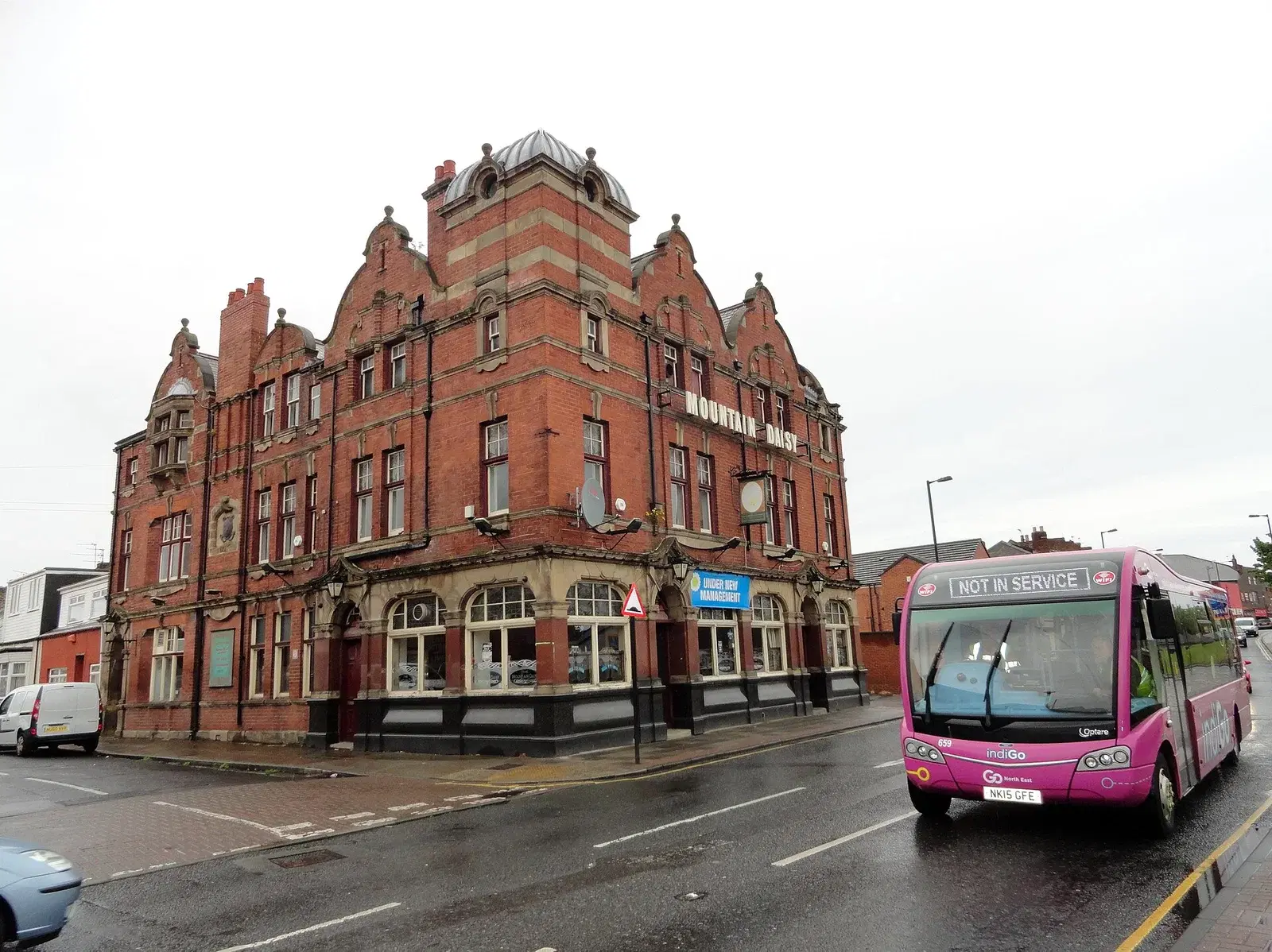
Mountain Daisy, Hylton Road
The Mountain Daisy in Millfield is the most important pub interior in the city. It is dated 1901, was designed by the Sunderland architects W and T R Milburn, and is listed Grade II*. CAMRA gives it three stars, its highest rating. The rear Buffet Bar is lined from floor to ceiling with Craven Dunnill tiles, including painted tile pictures of Durham Cathedral, the High Level Bridge in Newcastle and Bamburgh, with a mosaic floor and a curved ceramic bar counter that CAMRA describes as one of only fourteen left in the country.
The pub now serves mainly Asian food. CAMRA recorded it as temporarily closed from late October 2026, with reopening expected by the end of November, so check before you travel. The Buffet Bar is usually kept closed but can be seen on request.
Best for: The Mountain Daisy suits anyone with an interest in architecture, tiles or Edwardian design.
Museum Vaults, Silksworth Row
Museum Vaults on Silksworth Row dates from about 1867. It was a Vaux pub for much of its life, it was one of the last pubs in Sunderland to sell only beer (until 1978), and it has been run by the same family for more than forty years. The walls and shelves are full of local and football memorabilia, and a few hand-pulled beers are usually on.
Best for: Museum Vaults suits drinkers who like a traditional local with plenty of Sunderland stories on the walls.
Ship Isis, Silksworth Row
A few doors along, the Ship Isis was built in 1885 and is Grade II listed. It was remodelled in 1986, traded for a time as Livingstone's, and reopened under its old name in 2011. Today it has a long, narrow front bar with a row of handpumps for changing ales and ciders, a lounge, and an upstairs room. CAMRA's Sunderland and South Tyneside branch named it Branch Pub of the Year for 2025.
Best for: The Ship Isis suits real ale drinkers, and pairs naturally with Museum Vaults next door.
King's Arms, Deptford
Walk downhill from Silksworth Row towards the river and you reach the King's Arms on Beach Street, in the old industrial area of Deptford. A pub has stood here since 1834, and the present building is a rebuilding of 1889. It is Grade II listed, and CAMRA rates its interior as being of special national historic interest because of a Victorian bar-back thought to date from the 1860s or 1870s, which would make it an unusually early survival. Two open fires and barrel seating keep the old feel. It has been run by the team behind the Ship Isis since December 2023, and it opens from Wednesday to Sunday.
Best for: The King's Arms suits anyone who wants a fireside pint close to the river.
The Saltgrass, Ayres Quay
The Saltgrass sits at the foot of the bank at Ayres Quay, on Hanover Place, beside the site of a former shipyard. CAMRA records it trading as the Friendly Tavern in 1842, and its present name comes from the salt grass that once covered this part of the riverside. It has two rooms with open fires, beamed ceilings and wooden floors, plus a large outdoor area. Cask ale was withdrawn in 2025, so come for the setting rather than the handpumps.
Best for: The Saltgrass suits a slow afternoon in a traditional riverside pub with outdoor space.
Ivy House, Worcester Terrace
On the other side of the city centre, the Ivy House on Worcester Terrace occupies a building of the 1860s, about five minutes from the Park Lane Interchange. It is known for the stag's horn lights at each end of the bar and for local beers from breweries such as Hadrian Border, Firebrick and Full Circle. It won a CAMRA Lockdown Hero Award in 2021 and reopened after a refurbishment in August 2026.
Best for: The Ivy House suits anyone arriving by Metro or bus at Park Lane who wants a proper back-street pub.
The Canny Lad, Green Terrace
Many locals still call the Canny Lad by its old name, Fitzgeralds. It occupies a Grade II listed building on Green Terrace in the Bishopwearmouth conservation area, and as Fitzgeralds it spent thirty years in CAMRA's Good Beer Guide. It reopened under its new name with an Irish theme in spring 2025 and still keeps six handpulls, a games room in the old Chart Room and a small beer garden.
Best for: The Canny Lad suits real ale drinkers around Park Lane, and anyone who remembers Fitzgeralds.
A suggested route
The pubs fall into two clusters. Start at the Dun Cow and the Peacock on High Street West, walk west along Silksworth Row to Museum Vaults and the Ship Isis, then drop down to the King's Arms and the Saltgrass by the river. The Mountain Daisy is a short walk west along Hylton Road, close to Millfield Metro station. The Ivy House and the Canny Lad are best visited from Park Lane. Several of these pubs keep limited hours early in the week, so a Thursday to Sunday visit is the safest bet.
For the wider story of the city, read our short history of Sunderland, or browse the heritage hub.
Know a historic pub we have missed? Get in touch.
Local businesses mentioned
The Dun Cow
9 High Street West, Sunderland, SR1 3HA
The Peacock
287 High Street West, Sunderland, SR1 3ES
Mountain Daisy
150 Hylton Road, Millfield, Sunderland, SR4 7XT
Museum Vaults
33 Silksworth Row, Sunderland, SR1 3QJ
Ship Isis
26 Silksworth Row, Sunderland, SR1 3QJ
King's Arms
Beach Street, Deptford, Sunderland, SR4 6BU
The Saltgrass
Ayres Quay, Hanover Place, Deptford, Sunderland, SR4 6BY
Ivy House
7A Worcester Terrace, Sunderland, SR2 7AW
The Canny Lad
12-14 Green Terrace, Sunderland, SR1 3PZ
Never miss what’s on
Join the weekly SunderlandCity.live digest — the best events, news and local tips, straight to your inbox. One email a week.
What's On
Witches, Fairies and Satan: Folk Tales of County Durham
1:00 PM · Arts Centre Washington, Biddick Lane, Fatfield, Washington, NE38 8AB
Frozen Assets
7:30 PM · Arts Centre Washington, Biddick Lane, Fatfield, Washington, NE38 8AB
Spotlight: Washington Open Exhibition 2026
See website · Arts Centre Washington, Biddick Lane, Fatfield, Washington, NE38 8AB