The Lambton Worm: Wearside's Dragon Legend
The Lambton Worm beyond the song: the two hills that claim the legend, the curse on the Lambton family, the 1867 song, Lambton Castle and where the worm turns up in books, film and football.
Almost everyone who grows up on Wearside knows the Lambton Worm, usually from the song before the story. It has all the parts of a classic dragon story: a young heir, a monster that grows from something small, a knight's return, and a price to pay. The basic tale is told in our Penshaw Monument and Herrington Country Park guide. This guide looks at the parts that usually get left out: the different versions, the hills, the family curse, the song and the worm's long afterlife.
The story in brief
The young John Lambton, heir to the Lambton estate, skips church one Sunday to go fishing in the Wear. He catches nothing until the service ends, then pulls out a small eel-like creature with nine holes on each side of its head. Declaring he has "catched the devil", he throws it down a well and forgets about it. He grows up and, as a penance for his wild youth, goes to fight in the Crusades.
While he is away the creature grows huge, poisons the well and coils itself around a hill. It eats sheep, stops cows giving milk and carries off small children. Lambton's father keeps it quiet with a daily trough filled with the milk of nine good cows. Villagers and passing knights who attack it are killed, and when it is cut in half the pieces simply join together again.
After seven years John comes home and asks a wise woman near Durham for advice. She tells him to stud his armour with spearheads and fight the worm in the river, where the current will carry the severed pieces away before they can rejoin. There is a condition: once the worm is dead he must kill the first living thing he sees, or nine generations of Lambtons will not die in their beds.
Different tellings
The legend has been told and retold for centuries, and the details change from one version to the next. In some tellings the person who warns John at the riverbank is an old man; in others it is a witch. The worm is sometimes no bigger than a thumb when it is caught and sometimes about three feet long. Some versions give it legs, others make it closer to a snake. In some, John kills it with a sword of the type known as an Andrew Ferrara, and a sword of that kind dated 1521 was once kept at the Lambton manor as the one he was said to have used.
A version was published by the folklorist Joseph Jacobs in More English Fairy Tales, using a text from William Henderson's Folk-Lore of Northern Counties, and this helped spread the story well beyond the North East.
Worm Hill or Penshaw Hill?
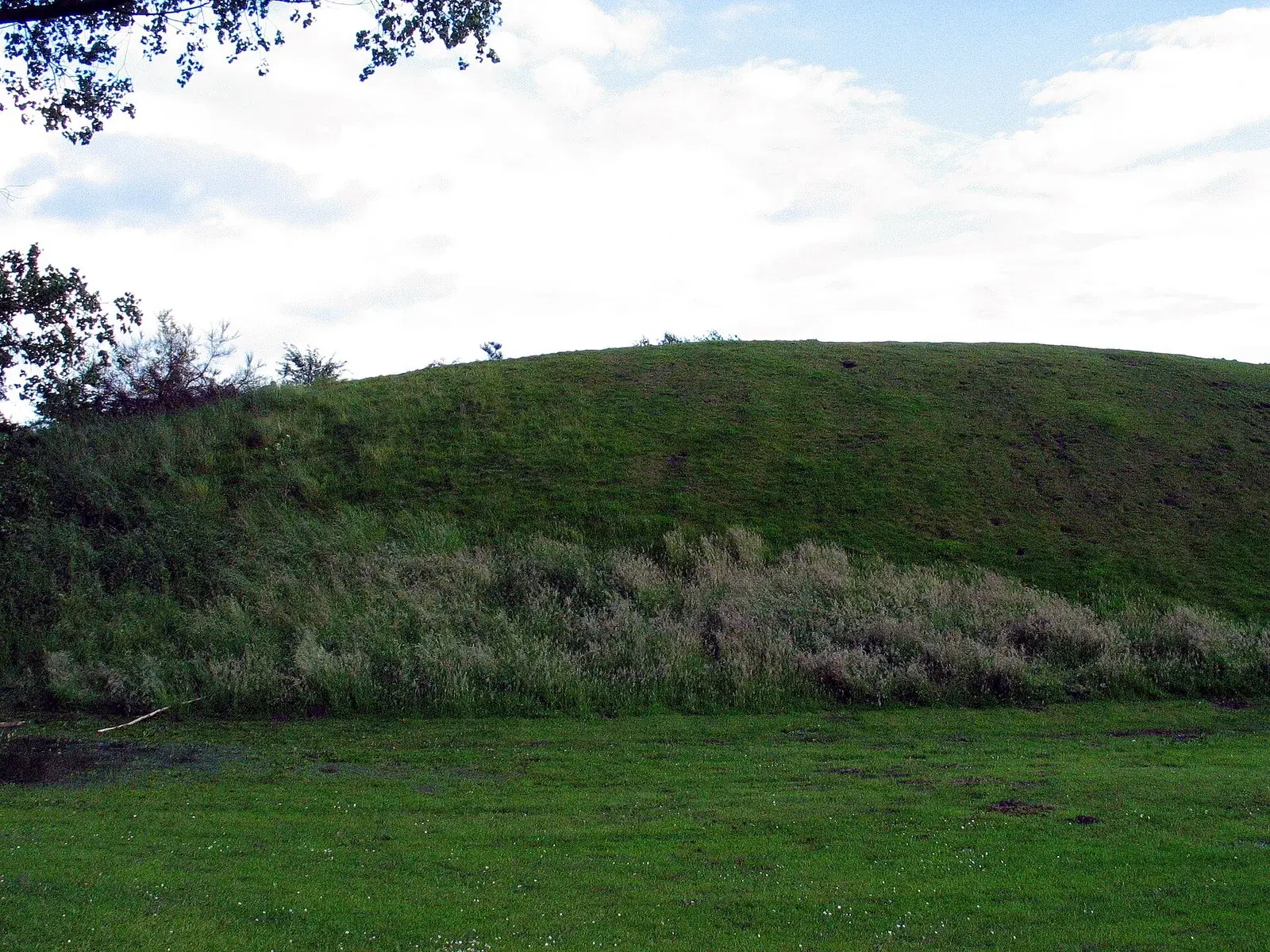
The most familiar version, from the song, has the worm wrapping itself around Penshaw Hill, the hill now topped by Penshaw Monument. But earlier and more local versions put it on Worm Hill at Fatfield, a much smaller mound beside the River Wear in Washington. In many versions the worm is long enough to wrap around the hill seven times, and it was said that the marks of its coils could still be seen in the ground. The song's switch to Penshaw is usually explained by the size of the two hills: Worm Hill is very small, and Penshaw Hill is a far more dramatic setting.
The Lambton curse
The ending is where the legend turns dark. When John kills the worm and blows his hunting horn three times, his father is meant to release a favourite hound, which John will then kill to satisfy the condition. Instead the old man, overjoyed, runs out himself. John cannot kill his father. The hound is released and killed afterwards, but it is too late, and the curse falls on the family.
Part of the reason the story lasted is that the Lambtons appeared to live up to it. Tradition lists Robert Lambton as drowned at Newrig, Sir William Lambton, a colonel of foot, as killed at Marston Moor, and another William Lambton as dying in battle at Wakefield. The ninth generation is counted as Henry Lambton, who died in his carriage while crossing Lambton Bridge on 26 June 1761. His brother, a general, is said to have kept a horse whip by his bed to fend off attackers, and he died in his bed in old age.
Lambton Castle
The Lambton family seat is Lambton Castle, which stands above Chester-le-Street. The present building was largely constructed between 1820 and 1828 for John Lambton, the first Earl of Durham, around an older house called Harraton Hall. It was designed by Joseph Bonomi the Elder and his son Ignatius in the style of a Norman castle. Later additions were mostly pulled down in 1932 because of subsidence, and in the 1930s the family moved to nearby Biddick Hall.
The castle is Grade II* listed. From 1972 to 1980 the grounds housed the Lambton Lion Park, and in 2012 the castle was used as a setting for the BBC One drama The Paradise. The estate is private.
The song
The version most people know is the song "The Lambton Worm", written in 1867 by C. M. Leumane to a tune from a Tyneside pantomime of the same year. It passed into oral tradition, so singers' versions vary, most famously over whether the worm has "goggly" or "googly" eyes, an old Wearside word for bulging, searching eyes. The song is full of words found only in Northumbrian dialect.
The worm's afterlife
The legend has fed a long list of later work. Bram Stoker's 1911 novel The Lair of the White Worm draws heavily on it, and Ken Russell's 1988 film of the novel reworks Leumane's song as the "d'Ampton Worm". Robert Sherlaw Johnson wrote an opera, The Lambton Worm, in 1978, with a libretto by the poet Anne Ridler. Bryan Talbot retells the story in his graphic novel Alice in Sunderland, and William Mayne's children's novel The Worm in the Well (2002) is another retelling.
The worm is still part of Sunderland's identity. On 16 August 2025, Sunderland AFC supporters at the Stadium of Light unveiled a giant tifo of the Lambton Worm being slain.
See it today
Penshaw Hill is the obvious place to stand in the legend: the hill is open to walkers, and the monument is looked after by the National Trust. Our Penshaw guide has the practical details. Worm Hill at Fatfield is a small grassy mound beside the Wear in Washington, and it is worth combining with a visit to Washington Old Hall.
Best for: Lambton Castle sits on a private estate behind a high wall, so do not plan a visit around it. Penshaw Hill and Worm Hill are the places to see the legend on the ground.
Know a place we have missed? Get in touch.
Never miss what’s on
Join the weekly SunderlandCity.live digest — the best events, news and local tips, straight to your inbox. One email a week.
What's On
Witches, Fairies and Satan: Folk Tales of County Durham
1:00 PM · Arts Centre Washington, Biddick Lane, Fatfield, Washington, NE38 8AB
Frozen Assets
7:30 PM · Arts Centre Washington, Biddick Lane, Fatfield, Washington, NE38 8AB
Spotlight: Washington Open Exhibition 2026
See website · Arts Centre Washington, Biddick Lane, Fatfield, Washington, NE38 8AB