Historic Churches in Sunderland: Five Worth Visiting
Five historic Sunderland churches, from Benedict Biscop's St Peter's of 674 to Holy Trinity, the Minster, St Mary's and the Arts and Crafts interior of St Andrew's, Roker.
Sunderland's churches tell the city's story in stone. The oldest goes back to the 670s, when Monkwearmouth was one of the great centres of learning in Europe. Others were built as the port grew in the 18th century, rebuilt as the coalfield moved underneath them, or paid for by shipbuilding money at the start of the 20th century. This guide picks out five that are worth a visit for their history and architecture. Three are listed Grade I.
Most of these are working churches, so the best time to visit is outside service times, and opening hours can change around festivals and events. Where a church keeps regular visitor hours we give them; otherwise check with the parish before making a special trip.
St Peter's, Monkwearmouth
St Peter's is where Sunderland's recorded history begins. Benedict Biscop, a Northumbrian nobleman who had travelled to Rome several times, founded a monastery here in 674 to 675 on land given by King Ecgfrith. He brought masons and glaziers from Gaul to build in stone, at a time when most buildings in England were made of timber. The monastery and its twin at Jarrow became one of the leading centres of learning in Europe, and the Venerable Bede joined the community as a boy.
The west wall and the porch of Biscop's church survive, and the tower was raised above the porch by the late 10th century. Look closely at the west porch, where the Anglo-Saxon masonry is easy to tell apart from later work. The church is listed Grade I and is still an active parish church, standing on the north bank of the Wear beside the University of Sunderland's St Peter's campus.
Best for: St Peter's suits anyone interested in Anglo-Saxon England and the world of Bede.
Holy Trinity (Seventeen Nineteen), East End
When Sunderland became a separate parish in 1719, the new town needed its own church. Holy Trinity, on Church Street East in the old East End, was built in 1718 to 1719, possibly to a design by William Etty, and was consecrated on 5 September 1719. For more than two centuries it was the parish church of the port and its seafaring community. An apse was added in 1735 and a gallery around 1803.
As the population moved away from the East End, the church declined, and it closed as a parish church on 26 June 1988. It is now cared for by the Churches Conservation Trust, which carried out a £4.3m restoration and reopened the building as Seventeen Nineteen, a heritage and community venue. It is listed Grade I and is usually open from Wednesday to Friday, 10am to 4pm. In the churchyard stands the headstone of Jack Crawford, hero of the Battle of Camperdown, put up in 1888.
Best for: Holy Trinity suits visitors who want to see a Georgian church interior and learn about the old port town.
Sunderland Minster, Bishopwearmouth
The Minster Church of St Michael and All Angels and St Benedict Biscop stands at the western end of High Street West, in Bishopwearmouth. A parish has existed here since around 940, making it one of the oldest in the area. The building you see today is largely an early 20th-century rebuilding, needed after subsidence from colliery workings damaged the older church.
In 1998 it became Sunderland Minster, only the second parish church in England to be given the title in modern times, after Dewsbury. St Benedict Biscop was added to its dedication in 2007. It is listed Grade II* and is the civic church for the city. Its position, a short walk from the Empire and Park Lane, makes it an easy stop on a city centre visit.
Best for: The Minster suits city centre visitors and anyone interested in Sunderland's civic life.
St Mary's Roman Catholic Church, Bridge Street
St Mary's, on the corner of Bridge Street and St Mary's Way, is the earliest surviving Gothic Revival church in Sunderland. It was designed by Ignatius Bonomi, the Durham architect, and built between 1830 and 1835, opening on 15 September 1835. It was built in the years just after Catholic Emancipation in 1829. The tall, symmetrical front faces Bridge Street, a short walk from Wearmouth Bridge and Keel Square. It is listed Grade II and is still an active parish church.
Best for: St Mary's suits anyone exploring the city centre on foot between Wearmouth Bridge and the shops.
St Andrew's, Roker
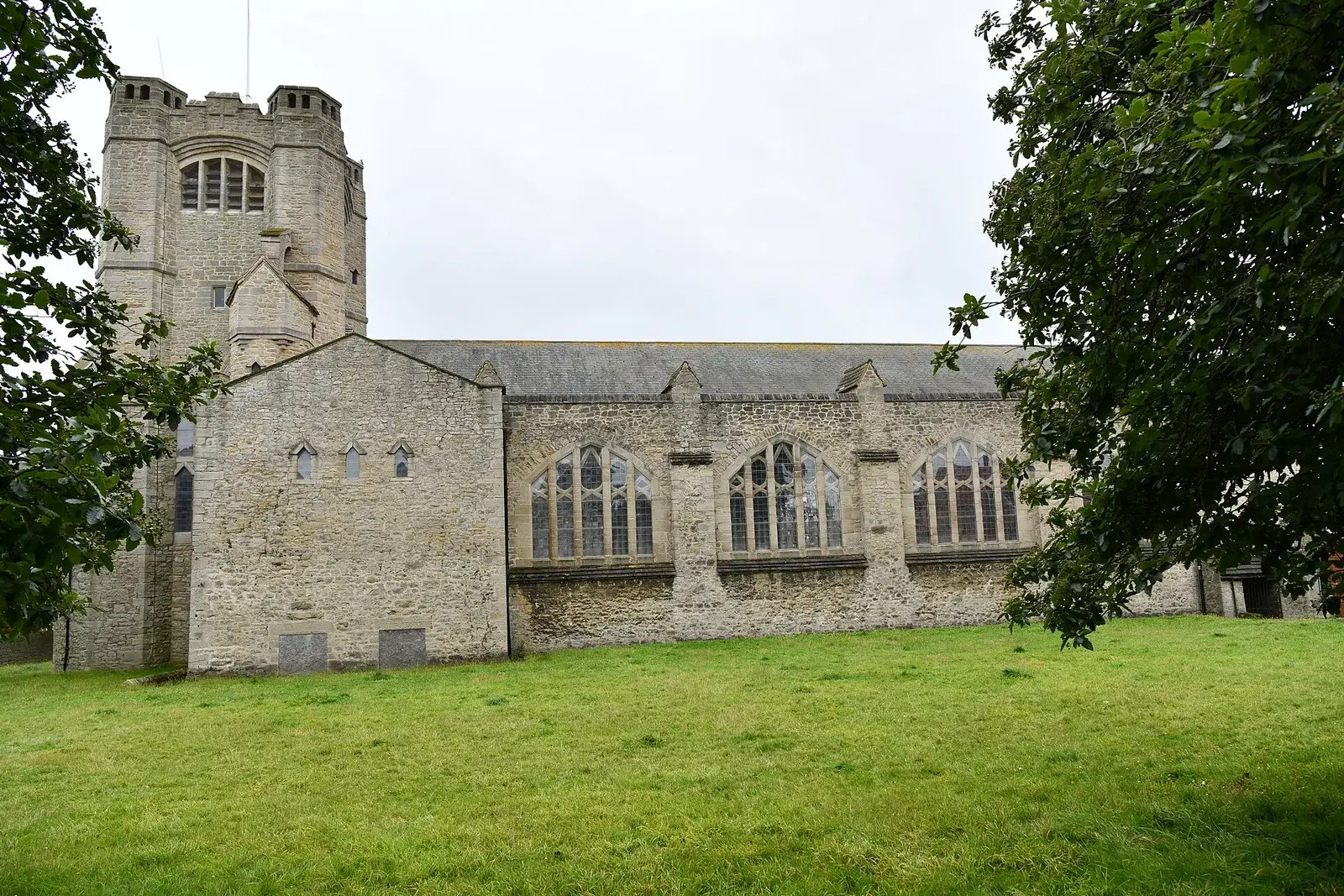
St Andrew's in Roker is the most remarkable church interior in the city and one of the most important Arts and Crafts buildings in the country. It was designed by Edward Schroeder Prior and built in 1905 to 1907, paid for largely by the shipbuilding family of John Priestman. Prior used local stone and concrete, with huge pointed arches springing almost from the floor, to create a broad, open interior.
Inside, almost every fitting was made by a leading designer of the movement. There is a Morris & Co tapestry based on a design by Edward Burne-Jones, furniture by Ernest Gimson, a foundation stone and lettering by Eric Gill, a painted chancel ceiling by MacDonald Gill, stained glass by Henry Payne, and a font cover by Robert Thompson, the "Mouseman" of Kilburn, whose carved mouse you can find on the woodwork. The church is listed Grade I and is often called the "Cathedral of the Arts and Crafts Movement". The entrance is on Talbot Road, a few minutes' walk from the seafront.
Best for: St Andrew's suits art and design lovers, and pairs well with a walk along the Roker seafront.
Visiting tips
St Peter's and St Mary's are close to the city centre and can be combined with the heritage walking trail, which also passes Holy Trinity. St Andrew's is about 2km north of the city centre in Roker, so it fits well into a day on the coast; our Roker and Seaburn seafront guide has more ideas for that part of the city. Please respect services, weddings and funerals, and check opening times before travelling, especially outside the summer months.
For more on how the city grew around these buildings, read our short history of Sunderland, browse the heritage hub, or see our free things to do in Sunderland.
Know a church we have missed? Get in touch.
Never miss what’s on
Join the weekly SunderlandCity.live digest — the best events, news and local tips, straight to your inbox. One email a week.
What's On
Witches, Fairies and Satan: Folk Tales of County Durham
1:00 PM · Arts Centre Washington, Biddick Lane, Fatfield, Washington, NE38 8AB
Frozen Assets
7:30 PM · Arts Centre Washington, Biddick Lane, Fatfield, Washington, NE38 8AB
Spotlight: Washington Open Exhibition 2026
See website · Arts Centre Washington, Biddick Lane, Fatfield, Washington, NE38 8AB