Famous People from Sunderland: Inventors, Writers, Musicians and Footballers
From Joseph Swan and James Herriot to Dave Stewart, Kate Adie and Jordan Henderson, the people who grew up on Wearside and where to find their traces in the city today.
Sunderland has produced inventors, writers, broadcasters, musicians and a long line of footballers. Some left as children and some stayed, but many of them have left a mark on the city in the form of a statue, a blue plaque or a building you can still visit. This guide picks out the best-known names, separates the people actually born here from those with a looser connection, and points to the places where you can follow their stories. For the wider background, start with our history of Sunderland.
Joseph Swan, the light bulb pioneer
Joseph Swan was born on 31 October 1828 at Pallion Hall in Sunderland. As a young apprentice in the town he attended lectures on electric arc lighting at the Sunderland Athenaeum, which fed his interest in the subject. He went on to develop an incandescent light bulb with a carbon filament, and gave his first public demonstration of a working lamp in Newcastle on 18 December 1878. He repeated the lecture in Sunderland on 17 January 1879.
Swan moved to Newcastle as a young man, so most of his later work happened on Tyneside, but Sunderland claims him as a son of the town and his name appears on streets and buildings across Wearside.
Best for: Suits anyone interested in science and invention; pair it with a visit to the Discovery Museum in Newcastle.
James Herriot, the vet who started in Roker
The writer known to millions as James Herriot was born Alf Wight in 1916 on Brandling Street in Roker. His family moved to Glasgow when he was only a few weeks old, so he grew up Scottish and later made his name as a vet in North Yorkshire. In September 2021 a blue plaque, funded by the Sunderland Antiquarian Society, was unveiled on Brandling Street by his children, Jim Wight and Rosie Page.
The plaque is a short walk from the seafront, so it fits easily into a day at the coast. Our Roker and Seaburn seafront guide covers the rest of the area.
Best for: Suits readers of the Herriot books and anyone walking the Roker seafront.
Statues in Mowbray Park
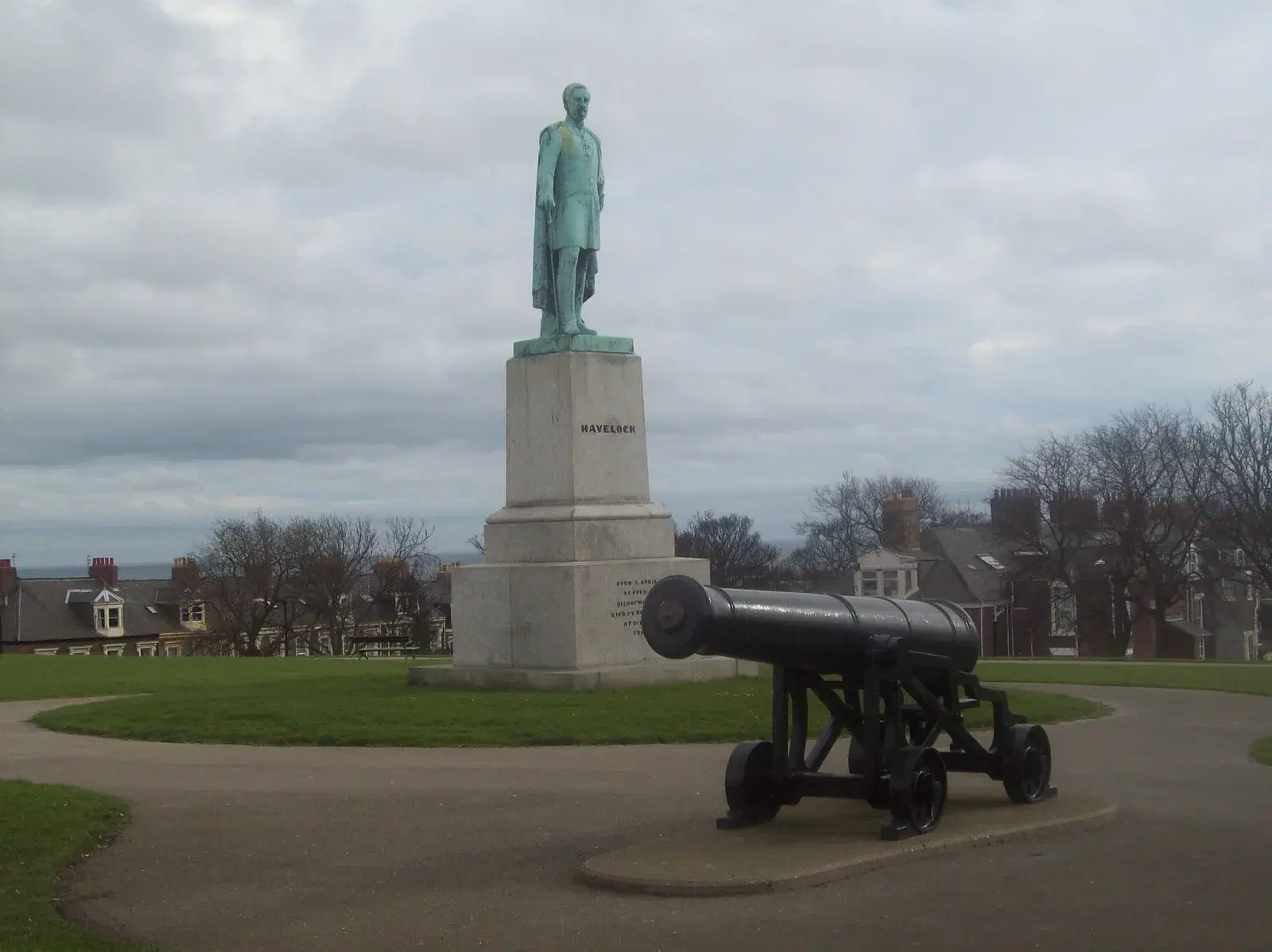
Mowbray Park, opened in 1857 on Building Hill, holds several statues of people tied to the town.
- Sir Henry Havelock, the army general, was born at Ford Hall in Bishopwearmouth. His bronze statue by William Behnes, dated 1861, stands on the hill flanked by two cannons.
- Jack Crawford was born in Sunderland in 1775 and became a national hero after he climbed the mast of HMS Venerable at the Battle of Camperdown in 1797 and nailed the colours back in place. He died of cholera in 1831. His statue by Percy Wood dates from 1889-90.
- The walrus by Andrew Burton, near the lake, refers to Lewis Carroll's poem "The Walrus and the Carpenter". Carroll was not from Sunderland, but he often visited relatives at Whitburn and Southwick, and the poem is said to have been written at Whitburn.
The park is open daily. Note that the neighbouring Sunderland Museum and Winter Gardens closed in August 2026 for refurbishment, with reopening planned for 2028, so it cannot be combined with a park visit for now.
Best for: Suits a short history walk in the city centre with children or visitors.
Writers and broadcasters
Kate Adie was born in Whitley Bay in 1945 and adopted as a baby by John and Maud Adie, a Sunderland pharmacist and his wife. She grew up in the town, attended Sunderland Church High School and went on to become the BBC's chief news correspondent. The University of Sunderland holds an archive of her papers known as the Kate Adie Collection.
Terry Deary, author of the Horrible Histories books, was born in Sunderland in 1946. Marion Angus, the poet, was born in Sunderland in 1865 and later became known for her Scots verse.
Musicians
Dave Stewart of Eurythmics was born in Sunderland on 9 September 1952. He went to Barnes Infants and Junior schools and then Bede Grammar School before leaving for London. He marked his 70th birthday with a hometown concert at The Fire Station on High Street West.
Lauren Laverne was born Lauren Gofton in Sunderland in 1978. She formed the band Kenickie in 1994 with friends from local Catholic schools before moving into radio and television.
Emeli Sandé was born in Sunderland in 1987 to a Zambian father and an English mother, who met as students in the town. The family moved to Aberdeenshire when she was four.
Two other musicians come from Washington, now part of the city: Bryan Ferry of Roxy Music, born in 1945, and Alan Price of The Animals, born in Fatfield in 1942.
Best for: The Fire Station suits anyone who wants to see live music in a venue with a local story behind it.
Footballers
Sunderland has a long football tradition, and several of England's best-known players grew up here.
- Raich Carter was born in Hendon in 1913. He captained Sunderland, later played for Derby County and Hull City, and won 13 England caps.
- Jordan Henderson was born in 1990 and grew up in Farringdon. He joined Sunderland's academy at the age of eight, made his first-team debut in November 2008, then moved to Liverpool in 2011, where as captain he won the Champions League and the Premier League.
- Jordan Pickford was born in Washington in 1994 and came through the Sunderland academy before becoming England's goalkeeper.
- Jill Scott was born in Sunderland in 1987 and won the Women's Euro with England in 2022.
Cricket has its own Sunderland name: Bob Willis, who later captained England, was born in the town in 1949.
The volunteer-run Fans Museum at Monkwearmouth Station tells the story of the club and its players, and a tour of the Stadium of Light adds the modern side. See our Stadium of Light match day guide for more.
Best for: Suits football fans of any age, especially on a non-match day.
Inventors and engineers
Sir William Mills was born in 1856 on Wear Street in Southwick. He designed the Mills bomb, the hand grenade used by British forces from 1915, and was knighted in 1922. Southwick has a blue plaque trail that includes him alongside the area's Lewis Carroll links.
Gertrude Bell and Washington
Gertrude Bell, the traveller, archaeologist and diplomat, was born in 1868 at Washington New Hall, now known as Dame Margaret's Hall. A short distance away, Washington Old Hall, run by the National Trust, is the ancestral home of the family of George Washington, the first American president. Our things to do in Sunderland guide includes more on Washington village.
Best for: Suits a half-day trip with a garden walk and a house visit.
Where to learn more
The Sunderland Antiquarian Society runs a heritage centre on Douro Terrace and has funded blue plaques in the city. It is the best starting point for anyone researching a local figure or a family name. The heritage hub lists other places to explore.
Know a place we have missed? Get in touch.
Local businesses mentioned
Sunderland Antiquarian Society Heritage Centre
6 Douro Terrace, Sunderland, SR2 7DX
Washington Old Hall
The Avenue, Washington Village, Washington, NE38 7LE
The Fire Station
High Street West, Sunderland, SR1 3HA
Sunderland AFC (Stadium of Light)
Stadium of Light, Millennium Way, Monkwearmouth, Sunderland, SR5 1SU
The Fans Museum
Monkwearmouth Station, North Bridge Street, Sunderland, SR5 1AP
Never miss what’s on
Join the weekly SunderlandCity.live digest — the best events, news and local tips, straight to your inbox. One email a week.
What's On
Witches, Fairies and Satan: Folk Tales of County Durham
1:00 PM · Arts Centre Washington, Biddick Lane, Fatfield, Washington, NE38 8AB
Frozen Assets
7:30 PM · Arts Centre Washington, Biddick Lane, Fatfield, Washington, NE38 8AB
Spotlight: Washington Open Exhibition 2026
See website · Arts Centre Washington, Biddick Lane, Fatfield, Washington, NE38 8AB