A History of Roker Park
Sunderland AFC's home from 1898 to 1997: the Roker Roar, the Clock Stand, the 75,118 record crowd, the 1966 World Cup games and the housing estate that stands on the site now.
For 99 years Roker Park was the home of Sunderland AFC. It stood in Roker, a short walk inland from the seafront, and held crowds of more than 70,000 at its peak. The ground closed in 1997 when the club moved to the Stadium of Light, and the site is now a housing estate. This guide covers the ground's history, the big occasions it staged and what you can still find there. For the wider story of the club, see our history of Sunderland AFC.
Building the ground, 1898
By the late 1890s Sunderland had outgrown their Newcastle Road ground. The new site was farmland belonging to a Mr Tennant, and the pitch was laid with turf brought over from Ireland, which lasted 38 years before it was replaced.
The first event held there was not football but an "Olympic Games and Band Contest" on 12 August 1898. The ground was formally opened on 10 September 1898 by the 6th Marquess of Londonderry, and Sunderland marked the day by beating Liverpool 1-0, with Jim Leslie scoring the first goal at the new ground.
Growth and the Roker Roar
Roker Park grew in stages. The Roker End was concreted in 1912 and by 1913 the ground could hold around 50,000. In 1929 a new Main Stand designed by the football ground architect Archibald Leitch was built, with a criss-cross steel lattice along its balcony. The cost nearly bankrupted the club. The Clock Stand on the opposite side was rebuilt in 1936, a structure 375 feet long, and opened by Lady Raine.
What visiting players remembered was the noise. The packed terraces produced a sound that became known as the Roker Roar. The footballer Danny Blanchflower wrote that "nothing ever equalled the intensity of that wild roar at Roker Park".
The record crowd
The largest crowd in the ground's history came in March 1933, when 75,118 people watched Sunderland play Derby County in an FA Cup sixth-round replay. Sources differ on the exact day of that match, so we give only the month here.
During the Second World War a bomb fell on the pitch in 1943, and a police officer was killed nearby. In 1952 Roker Park became the second English ground after Highbury to install floodlights.
England, cup semi-finals and the 1966 World Cup
Roker Park was used for more than club football. England played Ireland there in 1899 and won 13-2, and the national side returned for further matches in 1920 and 1950. In 1955 the ground staged an FA Cup semi-final replay between Newcastle United and York City in front of 55,239 people.
Its biggest international role came in 1966, when it was one of the host grounds for the World Cup. To meet the requirements, seats were fitted in the Clock Stand and a roof was added to the Fulwell End, giving a capacity of 40,310. Roker Park hosted group games involving the Soviet Union, Italy and Chile, with the largest of them, the Soviet Union against Italy, watched by 27,793. It then staged the quarter-final between the Soviet Union and Hungary.
Best for: The Fans Museum in the former Monkwearmouth station holds Roker Park memorabilia; its opening days vary, so contact it before you visit.
Decline and the move
After the Hillsborough disaster and the Taylor Report that followed, new safety measures reduced Roker Park's capacity, which fell to around 22,500 by the 1990s. The club decided to build a new stadium at Monkwearmouth instead.
Sunderland's last competitive match at Roker Park was a 3-0 win over Everton. A farewell game followed against Liverpool, who had also been the opponents on the opening day in 1898. Sunderland won 1-0, and John Mullin scored the last goal at the ground, at the Fulwell End. Before the bulldozers arrived, Charlie Hurley, who had been voted the club's Player of the Century, dug up the centre spot so it could be taken to the Stadium of Light.
The move was felt across the city. A play, I Left My Heart at Roker Park by Tom Kelly and Paul Dunn, was staged in 1997, and the club in this period was followed by the BBC documentary series Premier Passions, broadcast in 1998.
What is on the site now
The ground was demolished and the site redeveloped as housing. The street names record what stood there: Promotion Close, Clockstand Close, Goalmouth Close, Midfield Drive, Turnstile Mews and Roker Park Close. Walking these streets, you are crossing what used to be the pitch and terraces.
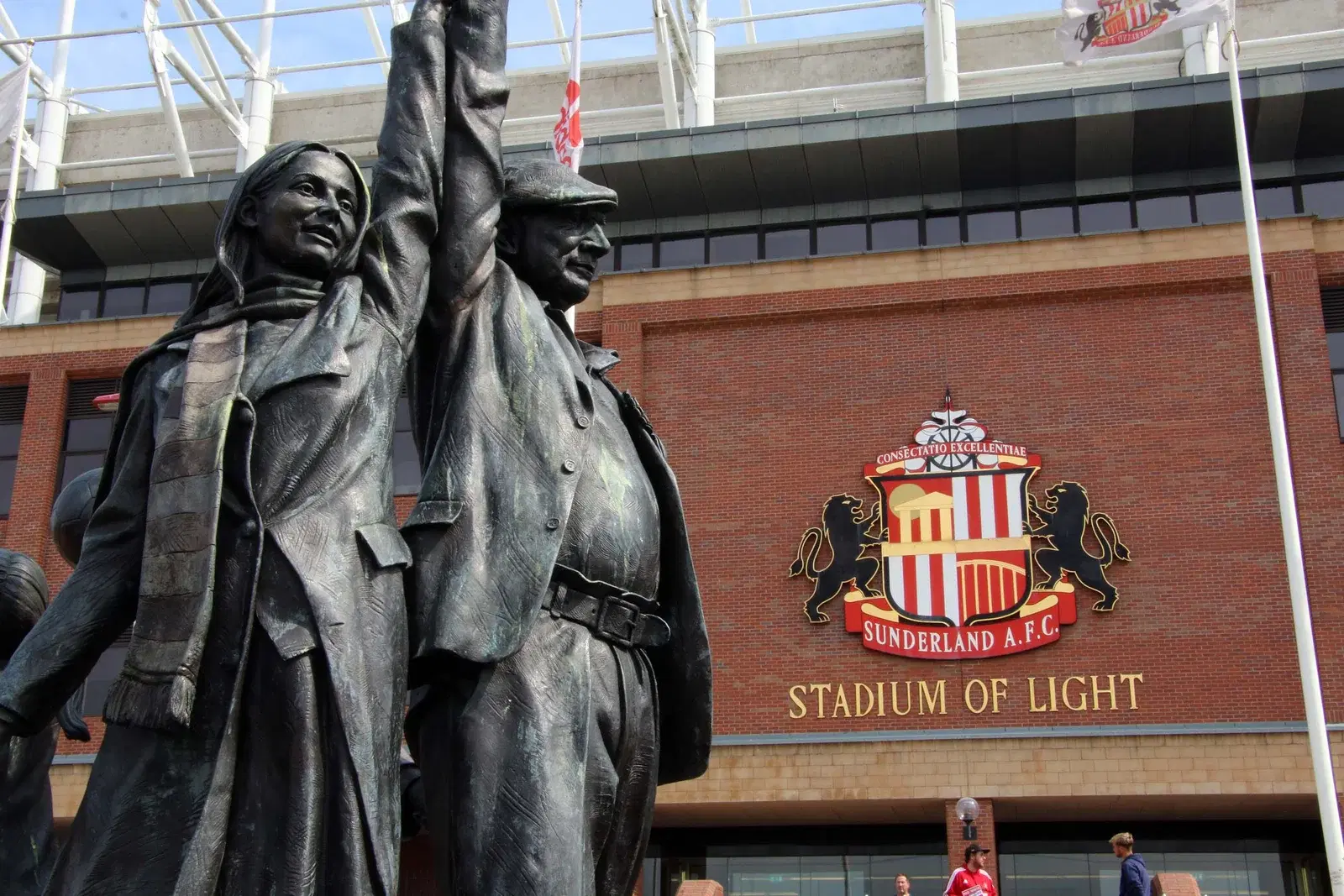
Some pieces of the old ground survived. Fragments of the Archibald Leitch lattice steelwork from the Main Stand were reused in the Stadium of Light car park, and in 2019 lattice-style boards were added at the Roker End of the new stadium as a nod to the old design. The club's Legends' Way scheme also plans to install the old Roker Park "Welcome to Sunderland" sign on the Roker End side of the Stadium of Light, on the route from the Keel Crossing.
Visiting
The Roker Park estate is a residential area, so be considerate if you walk round it. It is a short walk from the seafront and easy to combine with a walk along the promenade described in our Roker and Seaburn seafront guide. Nearby, Harbour View on Benedict Road shows live sport, and The Roker Hotel faces the sea.
For the objects rather than the place, the Fans Museum on North Bridge Street collects programmes, shirts and photographs from the Roker years. Admission costs nothing and donations are welcome. At the Stadium of Light look for the Leitch lattice in the car park and the Roker End boards; our Stadium of Light match day guide covers getting there. Other lost Sunderland landmarks are gathered in lost buildings of Sunderland.
Remember Roker Park, or know something we have missed? Get in touch.
Local businesses mentioned
Sunderland AFC (Stadium of Light)
Stadium of Light, Millennium Way, Monkwearmouth, Sunderland, SR5 1SU
The Fans Museum
Monkwearmouth Station, North Bridge Street, Sunderland, SR5 1AP
Harbour View
Benedict Road, Roker, Sunderland, SR6 0NU
The Roker Hotel
9-13 Roker Terrace, Roker, Sunderland, SR6 9ND
Never miss what’s on
Join the weekly SunderlandCity.live digest — the best events, news and local tips, straight to your inbox. One email a week.
What's On
Witches, Fairies and Satan: Folk Tales of County Durham
1:00 PM · Arts Centre Washington, Biddick Lane, Fatfield, Washington, NE38 8AB
Frozen Assets
7:30 PM · Arts Centre Washington, Biddick Lane, Fatfield, Washington, NE38 8AB
Spotlight: Washington Open Exhibition 2026
See website · Arts Centre Washington, Biddick Lane, Fatfield, Washington, NE38 8AB