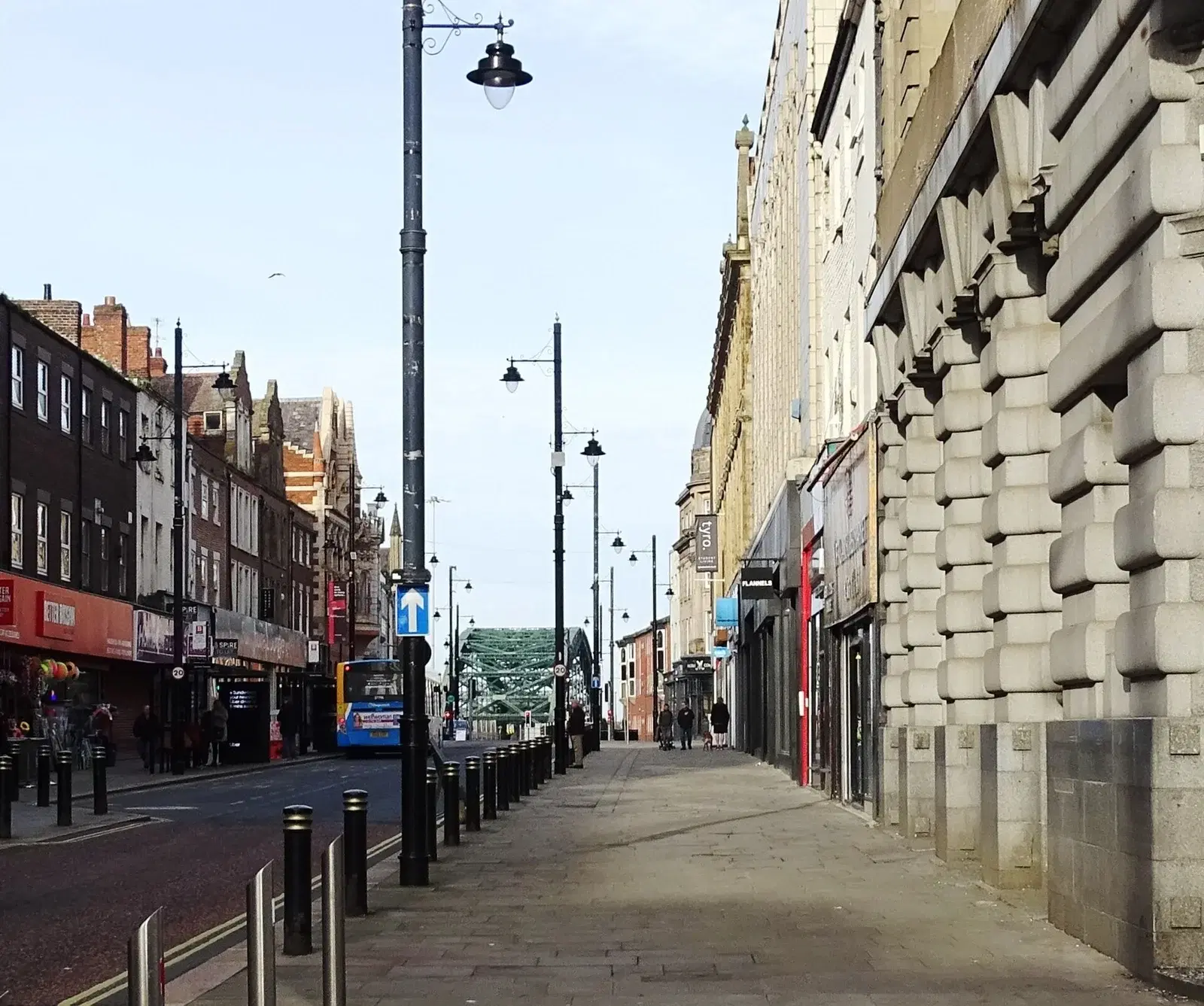
Lost Buildings of Sunderland: What Stood Here Before
The Town Hall, Binns, Joplings, the Havelock cinema, Roker Park, Vaux and the old Central station: the Sunderland buildings that have gone, with dates and what stands on the sites now.
Every city loses buildings, but Sunderland has lost more than most. Wartime bombing, the end of shipbuilding and coal mining, and waves of redevelopment from the 1960s onwards have swept away many of the places older residents remember. This guide looks at some of the best known, with the dates they opened and closed and what you will find on the sites today. Many of them can still be traced on a walk around the city centre if you know where to look.
Sunderland Town Hall, Fawcett Street
The Victorian Town Hall stood on Fawcett Street, designed by Brightwen Binyon. The foundation stone was laid on 29 September 1887 and the building opened on 6 November 1890, with a tall clock tower that dominated the street. The council moved to the new Civic Centre in November 1970, and the Town Hall was demolished in 1971 despite local opposition. Its bells were put into storage. Cassaton House, an office block, now occupies the site.
Best for: Stand on Fawcett Street and look for Cassaton House to find where the clock tower once rose.
Binns, Fawcett Street
Binns was Sunderland's best-known department store. The business was founded in 1807 and moved to Fawcett Street in 1884, where it expanded over the following decades. The store was badly damaged in an air raid in 1941 and rebuilt between 1949 and 1953, with a further building added in 1962. Binns closed in 1993, and its buildings have since been put to other uses.
Best for: The large stone frontages on Fawcett Street are the best clue to how much of the street Binns once filled.
Joplings, High Street West and John Street
Joplings moved into 126 to 129 High Street West in 1919, but the store burned down in a fire on the night of 13 to 14 December 1954. A new Joplings opened on John Street in May 1956 and traded for more than fifty years until it closed on 19 June 2010. Unlike most of the buildings in this guide, the John Street store still stands. It was converted to student flats in 2018 and was later bought by the city council.
Best for: Walk along John Street to see the 1950s Joplings building, one of the few lost stores whose shell survives.
The Havelock cinema, Fawcett Street
The Havelock stood on the corner of Fawcett Street and High Street West, on the site of the Havelock House drapery, which burned down in 1898. The cinema opened on 16 December 1915, and in 1929 it showed the first talking picture in the city, The Singing Fool, which drew around 120,000 people. It was renamed the Gaumont in 1960 and closed in 1963, and was later demolished. The top floor of Havelock House is still visible above the shops.
Best for: Look up at the corner of Fawcett Street and High Street West to see what remains of Havelock House.
The Picture House, High Street West
A short walk away, the Picture House on High Street West opened in 1912 and was known locally as "The Ranch". It closed in 1966 and was demolished to make way for The Bridges shopping centre.
Best for: The Bridges now covers the site, so this one survives only in old photographs and memories.
Victoria Hall, Toward Road
The Victoria Hall is remembered for the worst disaster in the city's history. On 16 June 1883, 183 children died in a crush on a staircase after a children's show. The hall continued in use for decades afterwards, but it was destroyed by a German bomb in 1941. An office block of the 1960s now stands on the site, and the memorial to the children stands in nearby Mowbray Park, where it was returned in 2002.
Best for: The Victoria Hall memorial in Mowbray Park is the place to remember the 1883 disaster.
Sunderland Central station
The original Sunderland Central station opened on 4 August 1879, designed by William Peachey, with a large arched roof. The roof was damaged by bombing during the Second World War and replaced in 1953. The station was then rebuilt, a project completed on 4 November 1965, and it was renamed simply Sunderland on 5 May 1969. A new southern entrance opened in December 2023.
Best for: The new southern entrance is the most visible change to the station since the 1960s rebuilding.
Roker Park
Sunderland AFC played at Roker Park from its opening on 10 September 1898 until 1997. The ground's record crowd was 75,118, for a cup replay against Derby County on 4 March 1933. After the club moved to the Stadium of Light, Roker Park was demolished in 1998, and the site is now housing. Street names such as Promotion Close and Turnstile Mews recall what was there.
Best for: Walk through Promotion Close and Turnstile Mews to stand on the site of the old pitch.
Wearmouth Colliery
Wearmouth Colliery, on the north bank of the Wear, began working in 1835, and coal mining there ended in 1993. The Stadium of Light opened on the site in 1997, and the Davy lamp sculpture outside the stadium is a reminder of the pit.
Best for: Visit the Stadium of Light to see how the colliery site was reused.
Vaux Brewery
Vaux was founded in 1806 by Cuthbert Vaux and was a Sunderland institution for almost two centuries, with its brewery on the edge of the city centre. The closure was announced in March 1999, and the site was cleared. Redevelopment followed slowly, and the new City Hall opened there in November 2021.
Best for: City Hall, overlooking the river, now stands where Vaux's brewery used to be.
The shipyards and docks
Most of Sunderland's shipyards have gone. The North Sands yard, run by J.L. Thompson and Sons, launched its last ship in May 1979 and was demolished for housing in 1986. On the south side of the river mouth, the North Hudson Dock warehouses, one of them designed by John Dobson in 1856, were demolished in 1992. Keel Square, with its Keel Line and thousands of ship names in the paving, is now the main memorial to the industry.
Best for: Keel Square is the place to find the names of the ships these yards produced.
Finding out more
For the bigger picture, read our short history of Sunderland, and see Sunderland in the Second World War for the buildings lost to bombing. The heritage walking trail passes several of the sites in this guide, and there is more on the heritage hub.
Remember a building we have missed? Get in touch.
Local businesses mentioned
Never miss what’s on
Join the weekly SunderlandCity.live digest — the best events, news and local tips, straight to your inbox. One email a week.
What's On
Witches, Fairies and Satan: Folk Tales of County Durham
1:00 PM · Arts Centre Washington, Biddick Lane, Fatfield, Washington, NE38 8AB
Frozen Assets
7:30 PM · Arts Centre Washington, Biddick Lane, Fatfield, Washington, NE38 8AB
Spotlight: Washington Open Exhibition 2026
See website · Arts Centre Washington, Biddick Lane, Fatfield, Washington, NE38 8AB