A History of Sunderland AFC
The story of Sunderland AFC from a teachers' club in 1879 to the Stadium of Light: six league titles, two FA Cups, Roker Park, the 1973 final and where to see the history today.
Sunderland AFC began as a club for schoolteachers and became one of the most successful sides of English football's early decades. Its story takes in six league championships, two FA Cup wins, a century at Roker Park and a move in 1997 to a new stadium built on the site of the city's last coal mine. This guide tells that story in order. For watching a match today, see our Stadium of Light match day guide, and for the wider football scene, including Sunderland AFC Women and the city's non-league clubs, see football in Sunderland.
A teachers' club, 1879
The club was founded in 1879 as Sunderland and District Teachers' Association Football Club. Its founder, James Allan, taught at Hendon Board School. In October 1880 the club dropped "Teachers" from its name and opened its membership to players from other professions, which allowed it to grow.
The early years were spent moving between grounds, starting at the Blue House Field in Hendon, before the club settled at Newcastle Road in 1886. Sunderland turned professional in 1885. Red and white stripes were adopted in the 1887-88 season and have been the club's colours ever since. Tom Watson became the first manager in 1888, the same year James Allan left to form a rival club, Sunderland Albion.
The team of all talents
Sunderland joined the Football League for the 1890-91 season. That spring, the league's founder William McGregor described them as "the team of all talents", a name that stuck. They won the league in 1891-92, again in 1892-93 and a third time in 1894-95, with Ned Doig in goal and Johnny Campbell scoring the goals. In April 1895 they beat the Scottish champions Heart of Midlothian 5-3 and were billed as "Champions of the World".
A painting from those years, Thomas M. M. Hemy's A Corner Kick, shows a match at Newcastle Road in the 1894-95 season. It hangs in the Stadium of Light today.
In 1898 the club moved to Roker Park, its home for the next 99 years. A fourth title followed in 1901-02 and a fifth in 1912-13, a season in which Sunderland also reached the FA Cup final, losing to Aston Villa at Crystal Palace. Charlie Buchan, who scored 221 goals for the club, was the forward of that era. In December 1908 Sunderland won 9-1 at St James' Park, still the largest margin in the Tyne-Wear derby.
The 1930s: a title and a cup
Between the wars Dave Halliday set a club record of 43 league goals in the 1928-29 season. The club's sixth and most recent league title came in 1935-36, when the side scored 109 goals and Raich Carter and Bobby Gurney each scored 31. The season was marked by tragedy: the goalkeeper Jimmy Thorpe died after a match against Chelsea.
A year later Sunderland won the FA Cup for the first time, beating Preston North End 3-1 at Wembley in 1937 with goals from Gurney, Carter and Burbanks. A supporter named Billy Morris took a black cat to the final, one of several stories linking the club to the animal that became its official nickname in 2000. Before then Sunderland were often called the Rokerites.
Post-war ups and downs
After the Second World War the club spent heavily on players such as Len Shackleton, Trevor Ford and Ivor Broadis and became known as the "Bank of England club". The money did not bring a trophy, and in 1958 Sunderland were relegated for the first time, ending 68 consecutive years in the top division.
1973
On 5 May 1973 Sunderland, then a Second Division club, beat Leeds United 1-0 in the FA Cup final at Wembley. Ian Porterfield scored, Jim Montgomery made a double save to keep Leeds out, and the manager was Bob Stokoe. Only two clubs from outside the top division have won the FA Cup since: Southampton in 1976 and West Ham United in 1980.
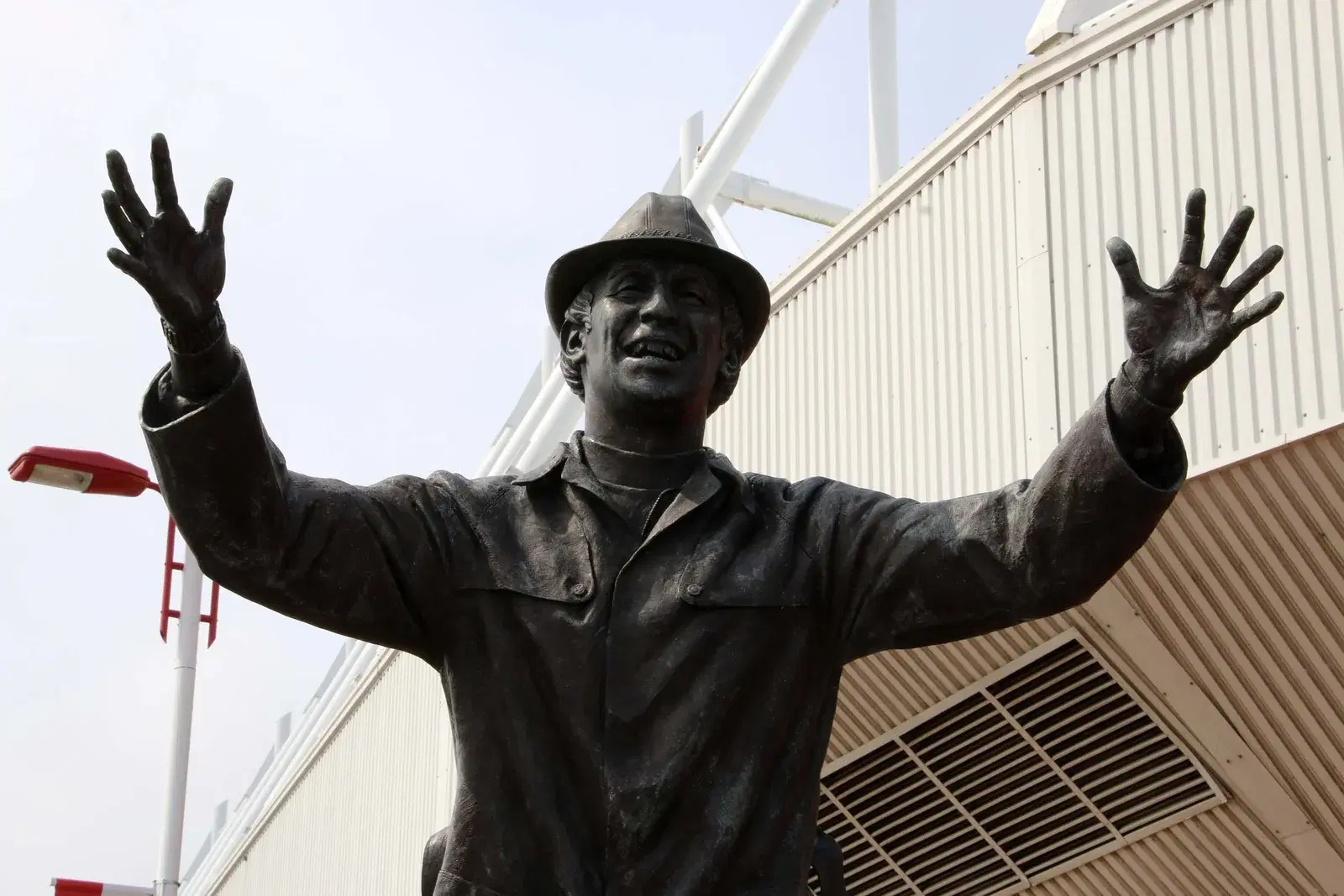
The cup win took Sunderland into Europe for the first time, in the Cup Winners' Cup, where they beat Vasas Budapest before losing to Sporting. A statue of Stokoe, arms raised, was unveiled outside the Stadium of Light in 2006.
Best for: The Stokoe statue stands outside the Stadium of Light and can be seen at any time from the public area around the ground, not only on match days.
From Roker Park to the Stadium of Light
The 1970s and 1980s were a period of movement between divisions. Sunderland won the Second Division in 1976, celebrated the club's centenary in 1979-80, reached the League Cup final in 1985 (losing to Norwich City) and dropped into the Third Division for the first time in 1987. Promotion in 1990 came after Swindon Town, who had won the play-off final, were demoted for financial irregularities. In 1992 Sunderland reached the FA Cup final again and lost to Liverpool. Under Peter Reid the club won the First Division in 1996.
In July 1997 the club left Roker Park for the Stadium of Light, built on the site of Monkwearmouth Colliery. The colliery had closed in 1993, the last pit on the Durham coalfield. The chairman Bob Murray chose the stadium's name with the miners' Davy lamp in mind, and a Davy lamp sculpture outside the ground marks the link. The stadium opened with around 42,000 seats and was later enlarged to about 49,000. The history of mining on the site is covered in our history of Sunderland guide.
The modern club
The first seasons at the new ground included a 4-4 play-off final against Charlton Athletic in 1998, lost on penalties, and a 105-point First Division title in 1999. Kevin Phillips then scored 30 Premier League goals in 1999-2000 and won the European Golden Shoe. The club's official charity, the Foundation of Light, was set up in 2001; since 2018 it has been based at the Beacon of Light next to the stadium.
Later years brought relegations into League One in 2018, documented in the Netflix series Sunderland 'Til I Die, followed by promotion through the play-offs in 2022 and again in May 2025, when Sunderland beat Sheffield United 2-1 at Wembley. For the club's current division, fixtures and squad, check the club's site for the current season.
See it today
The Stadium of Light is the starting point. Outside the ground you can see the Bob Stokoe statue and the Davy lamp sculpture, and the club runs stadium tours on selected non-match days; check safc.com for dates. Inside, A Corner Kick hangs in the stadium.
The Fans Museum, run by supporters in the former Monkwearmouth station on North Bridge Street, holds shirts, programmes and memorabilia from across the club's history. Its opening days vary from week to week, so contact the museum before you go. General admission costs nothing and donations are welcome.
For a drink near the ground, the Colliery Tavern stands opposite the stadium on Southwick Road. The site of Roker Park itself is now housing, with street names that recall the old ground; our history of Roker Park explains what to look for, and what is a Mackem covers the name given to the club's supporters.
Know a piece of Sunderland AFC history we have missed? Get in touch.
Local businesses mentioned
Sunderland AFC (Stadium of Light)
Stadium of Light, Millennium Way, Monkwearmouth, Sunderland, SR5 1SU
The Fans Museum
Monkwearmouth Station, North Bridge Street, Sunderland, SR5 1AP
Beacon of Light
Stadium Park, Sunderland, SR5 1SN
Colliery Tavern
12 Southwick Road, Monkwearmouth, Sunderland, SR5 1EQ
Never miss what’s on
Join the weekly SunderlandCity.live digest — the best events, news and local tips, straight to your inbox. One email a week.
What's On
Witches, Fairies and Satan: Folk Tales of County Durham
1:00 PM · Arts Centre Washington, Biddick Lane, Fatfield, Washington, NE38 8AB
Frozen Assets
7:30 PM · Arts Centre Washington, Biddick Lane, Fatfield, Washington, NE38 8AB
Spotlight: Washington Open Exhibition 2026
See website · Arts Centre Washington, Biddick Lane, Fatfield, Washington, NE38 8AB