St Peter's Church, Monkwearmouth and the Venerable Bede
The story of St Peter's, Monkwearmouth: Benedict Biscop's monastery of 674, the boyhood of Bede, the books made here, the layers of the building and how to visit today.
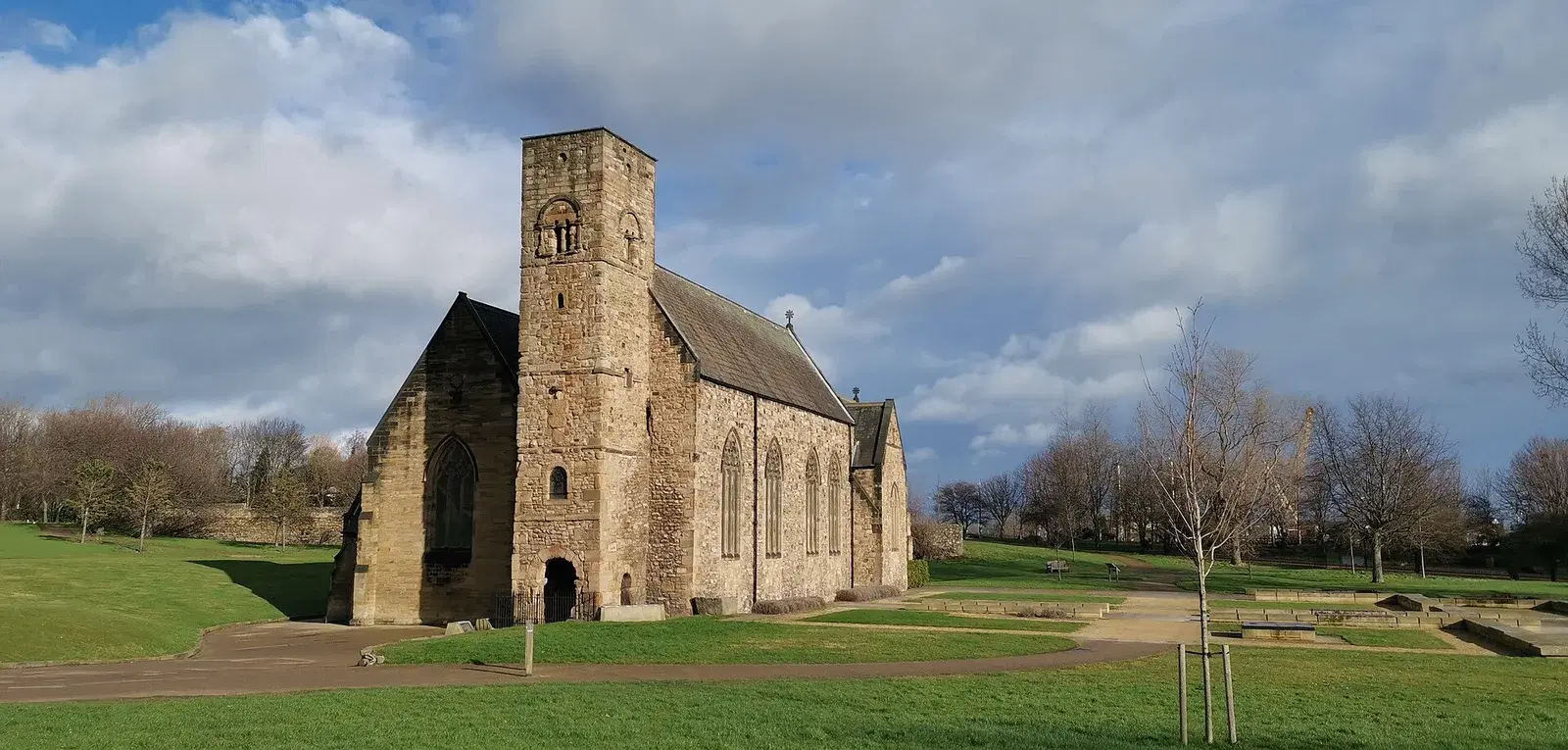
On the north bank of the Wear, between the university campus and the river, stands a small stone church with a tall, narrow tower. St Peter's Church, Monkwearmouth was founded in 674 and parts of it have stood for more than thirteen centuries. It is still a working parish church, and it is where the Venerable Bede, the scholar who gave England its first history of itself, spent his early childhood. Our history of Sunderland sets the church in the wider story of the city, and churches in Sunderland gives a short architectural summary. This guide goes further into the monastery, the people and the building.
A monastery in two places
St Peter's was founded by Benedict Biscop, who was well travelled in mainland Europe. King Egfrith of Northumbria granted him the land, and the church itself suggests it was probably the site of an earlier settlement founded by Hilda of Whitby. Biscop wanted a church in the Roman manner, built of stone, so he brought masons and glassmakers from Francia. Glass windows were then unusual in England. The glassmakers had their workshop at Monkwearmouth, near the river, and excavations here have found glass from the 7th and 8th centuries.
In 682 Egfrith gave more land, about seven miles away on the Tyne, and the sister church of St Paul's, Jarrow, was dedicated in 684 or 685. Before he died, Biscop laid down that the two houses should work as "one monastery in two places". Biscop also brought John, arch-cantor of St Peter's in Rome, to teach the monks to sing the liturgy in the Roman way. By 716 the double monastery is said to have had around 600 monks.
Bede's boyhood at Wearmouth
Bede was born in 672 or 673 on land that belonged to the monastery. At the age of seven his family placed him in the care of Benedict Biscop to be educated, and later of Ceolfrith. When Ceolfrith went to found the Jarrow house in 682, Bede probably went with him. In 686 plague struck Jarrow. The Life of Ceolfrith, written around 710, records that only two survivors could still sing the full office: Ceolfrith and a young boy. The boy was almost certainly Bede, then about fourteen.
He stayed in the double monastery for the rest of his life. He was made a deacon at nineteen, around 692, and a priest around 702, both times by Bishop John of Hexham. He died at Jarrow on 26 May 735.
The books
Biscop brought books back from Rome and Lérins Abbey, Ceolfrith added more from the Continent, and the library grew to around 200 books. Bede used it to write more than 60 works on scripture, grammar, science, saints' lives and time itself. His study of computus, the calculation of the date of Easter, helped make counting years from the birth of Christ, the AD system, the normal way of dating in Europe.
His best known work, the Ecclesiastical History of the English People, was finished around 731 and dedicated to King Ceolwulf of Northumbria. It runs from Julius Caesar's invasion of Britain to Bede's own day and is the reason he is often called the "Father of English History".
The scriptorium also produced the Codex Amiatinus, one of three giant one-volume Bibles ordered by Abbot Ceolfrith in 692. It has 1,040 leaves, weighs about 34kg, and one estimate puts the number of calf skins needed at 515. In 716 Ceolfrith set out to carry it to the Pope as a gift, but he died on the way at Langres in France. The book survived and is now in the Laurentian Library in Florence. It is the earliest complete one-volume Latin Bible to survive, and Bede was most likely involved in making it.
After the monks
The monastery was sacked by Viking raiders in the 9th century and abandoned. In the early 14th century both Wearmouth and Jarrow were re-established as small cells of Durham Priory, and they were dissolved in 1536. Bede's remains had been moved to Durham Cathedral, where his tomb is in the Galilee Chapel. In 1899 Pope Leo XIII declared him a Doctor of the Church, the only native of Great Britain to receive that title.
Reading the building
The church today is several buildings layered on top of each other. The oldest part is Biscop's west wall and the porch at its centre. The ground floor of the porch has a barrel vault, and its outer arch is decorated with carved stone. By around 700 a second storey had been added, and by the end of the 10th century more storeys had raised the porch into the tower you see today.
Later centuries added their own layers. The north aisle is 13th century and the five-light east window is 14th century. In the early 19th century the north arcade and most of the chancel arch were taken out and galleries put in, and the church was restored in 1875 and 1876 by the architects Austin and Johnson. Look for the medieval stonework still visible at the south side of the chancel arch.
The 20th century brought its own changes. Stained glass lost to bombing in the Second World War was replaced in 1969 by windows by Leonard Evetts showing northern saints; his glass is also at St Paul's, Jarrow. An octagonal extension for visitors was added in 1973. In 1984 an arson attack badly damaged the church, and the interior and roof were rebuilt. After the fire the nave sanctuary and exhibition area were created, the chancel ceiling was repainted and a Copeman-Hart organ was installed.
St Peter's is Grade I listed and part of a scheduled monument, and it remains the parish church of Monkwearmouth.
Visiting
The church is on St Peter's Way, Sunderland SR6 0DY, in open grassland beside the University of Sunderland's St Peter's campus and close to the river. St Peter's Metro station, on the northern approach to the railway bridge over the Wear, is the nearest stop.
According to the church, volunteer guides are available on weekdays from 10.30am to 2.30pm, but not on bank holidays. On Saturdays the church is closed unless a visit has been booked through the Parish Office, and it is not open for tours on Sundays outside services. Groups of ten or more need to book in advance. The Parish Office is staffed on weekday mornings from 9am to noon and can be reached on 0191 516 0135. Bede's Bakehouse, the church cafe, opens on Monday, Wednesday and Friday from 10.30am to 2.30pm.
Best for: Details of which weekdays the church is open vary between the church's own listings, so call the Parish Office before a special trip. Even when the door is locked, the west tower and its Anglo-Saxon porch can be seen from the churchyard.
To follow Bede's story to the end, cross to Jarrow, where Jarrow Hall has a reconstructed Anglo-Saxon farm and museum next to St Paul's, his other monastery. Back in the city centre, Sunderland Museum and Winter Gardens covers the wider history of Wearside, and the Culture House is a short trip across the Wearmouth Bridge.
Know a place we have missed? Get in touch.
Never miss what’s on
Join the weekly SunderlandCity.live digest — the best events, news and local tips, straight to your inbox. One email a week.
What's On
Witches, Fairies and Satan: Folk Tales of County Durham
1:00 PM · Arts Centre Washington, Biddick Lane, Fatfield, Washington, NE38 8AB
Frozen Assets
7:30 PM · Arts Centre Washington, Biddick Lane, Fatfield, Washington, NE38 8AB
Spotlight: Washington Open Exhibition 2026
See website · Arts Centre Washington, Biddick Lane, Fatfield, Washington, NE38 8AB