Sunderland on Screen: Film, TV and the Places Behind Them
Sunderland 'Til I Die, Premier Passions, the Empire premiere, Penshaw on television and the new Crown Works Studios: the city's screen story and the places you can visit.
Sunderland is better known on screen for real life than for drama. The city's most famous television appearance is a documentary about its football club, watched around the world, and its landmarks have turned up in films about the club, in regional campaigns and in the work of painters who came to record the river. This guide covers what we have been able to confirm from published sources, and where you can go to see the places involved. We have left out drama locations that we could not verify; if you know of one with a reliable source, please let us know.
Sunderland 'Til I Die
The best-known programme about the city is Sunderland 'Til I Die, a documentary series made for Netflix by Fulwell 73. The production company's founders are Sunderland supporters, and the company's name is a nod to the club's 1973 FA Cup win.
The first series, released on 14 December 2018, followed the 2017-18 season, when the club was relegated from the Championship. A second series, covering 2018-19 and the change of ownership, came out on 1 April 2020. A third and final series, following the 2021-22 promotion from League One, was released on 13 February 2024.
The opening titles show images from Sunderland's industrial past and use the song "Shipyards" by The Lake Poets, a Sunderland band. The series follows the club at the Stadium of Light. Guided stadium tours run on selected non-match days and take in the dressing room, the players' tunnel and the dugout. Our Stadium of Light match day guide covers getting there.
Best for: Suits fans of the series who want to see the stadium on a non-match day.
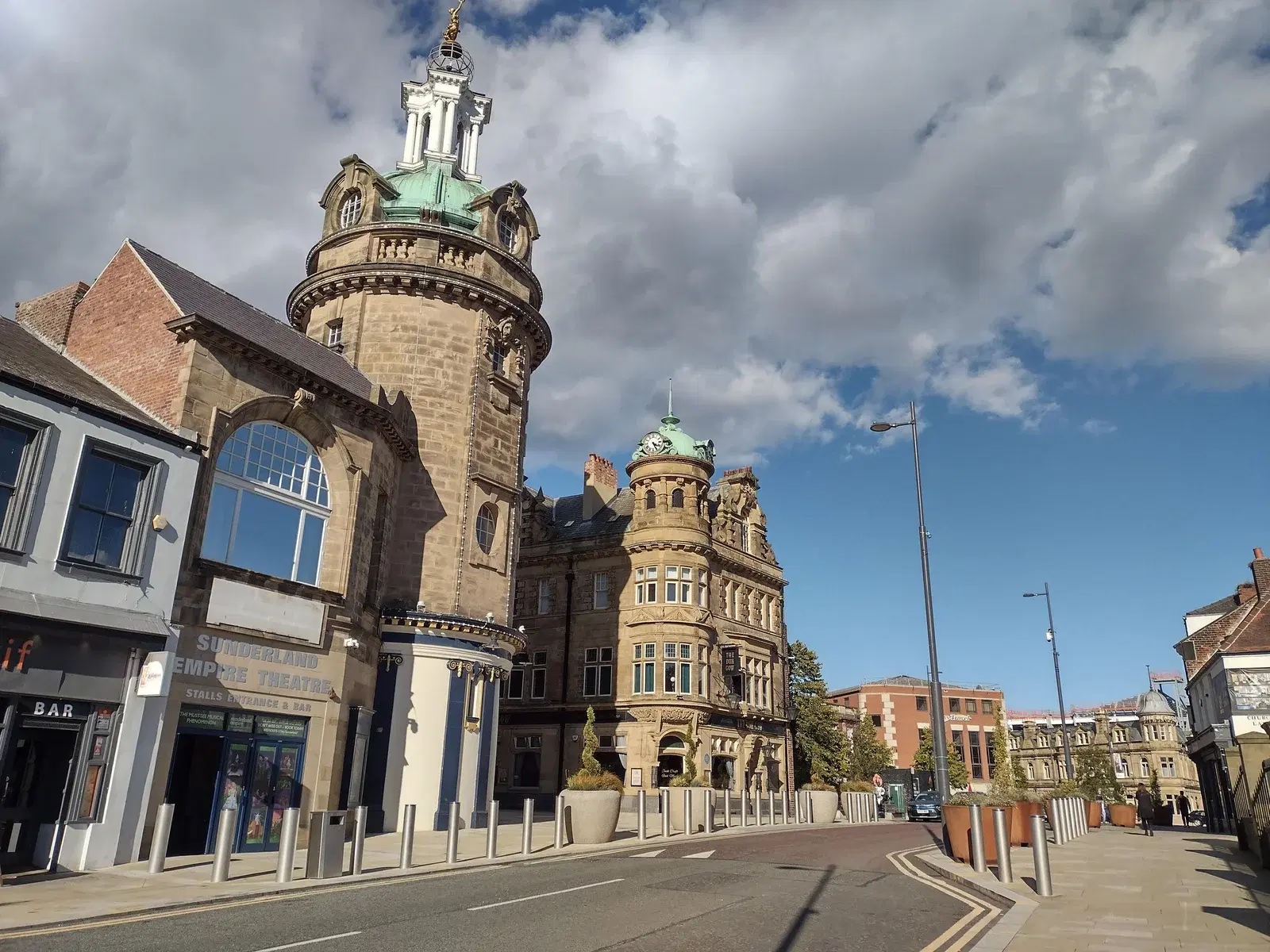
The premiere at the Empire
The first episode had its premiere at the Sunderland Empire on High Street West on 5 December 2018. Around 200 season ticket holders, chosen in a draw, joined players, staff and the production team.
The Empire has its own place in the story of screen entertainment. It opened in 1907 as a variety theatre and closed in May 1959, when television and cinema had drawn audiences away. The council bought the building and reopened it in 1960. The comedy actor Sid James, known for the Carry On films and Bless This House, collapsed on stage there during a performance in April 1976 and died on the way to hospital. Today the theatre stages touring musicals, plays, comedy and an annual pantomime.
Best for: Suits theatre-goers who want an evening in one of the North East's largest venues.
Premier Passions and the naming of the stadium
Sunderland 'Til I Die was not the club's first documentary. In 1998 the series Premier Passions followed a relegation season and became known for its candid dressing-room scenes. A follow-up, Premier Pressures, followed in 1999.
Premier Passions also captured a moment in the city's history. When chairman Bob Murray revealed the name of the new ground in 1997, the camera crew filmed him facing supporters, many of whom were unhappy with the choice. The name came from the Davy lamps carried by miners at Monkwearmouth Colliery, on whose site the stadium was built. A Davy lamp monument now stands at the entrance.
The volunteer-run Fans Museum at Monkwearmouth Station, a short walk from the stadium, holds memorabilia from the Roker Park and Stadium of Light eras.
Best for: Suits a combined visit with the stadium for supporters of all ages.
Penshaw Monument on television
Penshaw Monument, the Greek-style temple on Penshaw Hill, is one of the most recognisable shapes in the region. In 2006 it featured, alongside Hadrian's Wall and the Sage Gateshead, in a television advertisement for the "Passionate People, Passionate Places" campaign promoting North East England. The monument also appears on Sunderland AFC's crest. Our Penshaw Monument and Herrington Country Park guide covers walking routes and parking.
Best for: Suits a short walk with wide views, best in clear weather.
Lowry and the painted river
Before television, the painter L. S. Lowry recorded Sunderland's coast and shipyards. He stayed often at the Seaburn Hotel, and many of his seascapes and shipbuilding scenes were based on Wearside views. The main public collection of his Sunderland work is at Sunderland Museum and Winter Gardens, which closed in August 2026 for refurbishment and is due to reopen in 2028. In the meantime, the beach at Seaburn and the view from Roker Pier give a sense of the open seascapes he painted. See our Roker and Seaburn seafront guide.
Film in the city today
Sunderland held its first film festival in December 2003 in the Bonded Warehouse on the riverside, at a time when the city had no cinema. By the second festival, in January 2005, a new multiplex had opened in the city centre. That cinema is now the Omniplex Cinema Sunderland on Lambton Street, with twelve screens including a large-format screen.
The ITV Tyne Tees franchise has a regional office in the University of Sunderland's media centre, so some regional news is made in the city.
The biggest change ahead is Crown Works Studios, a planned film and television studio complex beside the Wear. It received government backing in March 2024, with Fulwell Entertainment among the main backers. Plans describe it as a regional centre for broadcast and film production. It is not open to visitors.
The new Culture House on Keel Square, which opened in September 2026, holds the City Library and exhibition space.
Best for: The Omniplex suits a rainy afternoon; see our rainy day in Sunderland guide for more ideas.
Alice in Sunderland
For a different kind of screen, the graphic novelist Bryan Talbot published Alice in Sunderland in 2007. It traces Lewis Carroll's links with the area, including his visits to Whitburn and Southwick, and weaves in the history of the city. The walrus statue in Mowbray Park refers to the same story, and our guide to famous people from Sunderland has more on Carroll's connections.
What we could not confirm
Several dramas are often said to have filmed in or near Sunderland. We have not listed specific titles or scenes here because we could not confirm them from a reliable published source. The heritage hub has the rest of our history guides.
Know a place we have missed? Get in touch.
Local businesses mentioned
Sunderland AFC (Stadium of Light)
Stadium of Light, Millennium Way, Monkwearmouth, Sunderland, SR5 1SU
Sunderland Empire
4-5 High Street West, Sunderland, SR1 3EX
The Fans Museum
Monkwearmouth Station, North Bridge Street, Sunderland, SR5 1AP
Penshaw Monument
Chester Road, Penshaw, Sunderland, DH4 7NJ
Omniplex Cinema Sunderland
4 Lambton Street, Sunderland, SR1 1TP
Culture House
Keel Square, High Street West, Sunderland, SR1 3DZ
Never miss what’s on
Join the weekly SunderlandCity.live digest — the best events, news and local tips, straight to your inbox. One email a week.
What's On
Witches, Fairies and Satan: Folk Tales of County Durham
1:00 PM · Arts Centre Washington, Biddick Lane, Fatfield, Washington, NE38 8AB
Frozen Assets
7:30 PM · Arts Centre Washington, Biddick Lane, Fatfield, Washington, NE38 8AB
Spotlight: Washington Open Exhibition 2026
See website · Arts Centre Washington, Biddick Lane, Fatfield, Washington, NE38 8AB