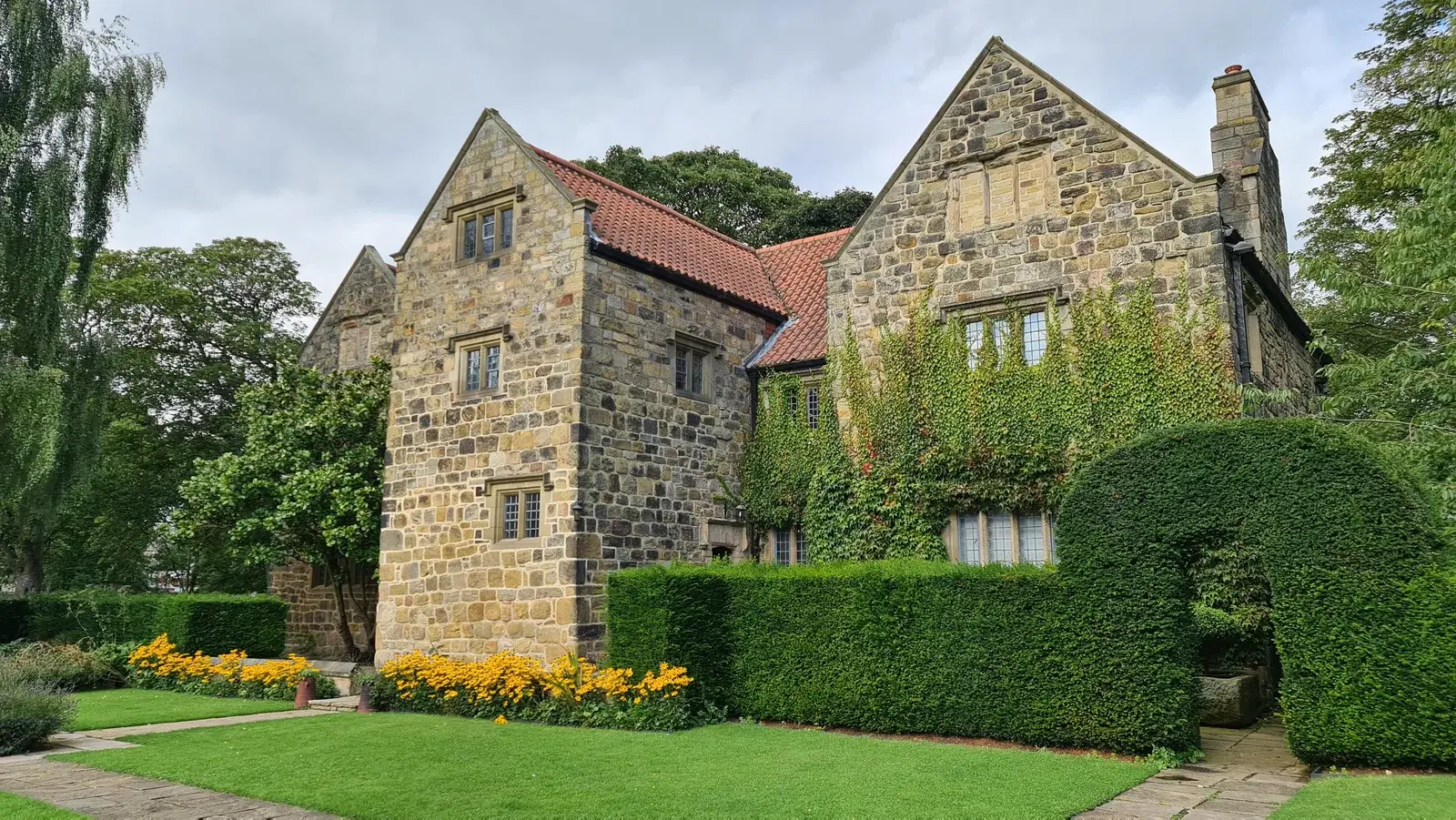
Washington Old Hall and George Washington: The Wearside Roots of a President
How a medieval Wearside family gave its name to Washington and to America's first president, how the Old Hall was saved in the 1930s, and what you can see there today.
The village at the heart of Washington is much older than the new town that grew up around it in the 1960s, and it has a claim that few places in England can match: it gave its name to the family of America's first president. Washington Old Hall, a small sandstone manor house on The Avenue, stands on the site of the family's medieval home. This guide explains the connection, how the house came close to demolition, and what you can see on a visit.
From Hertburne to Wessyngton
The story begins around 1180, when a knight called William de Hertburne exchanged his manor at Hartburn for the manor of Wessyngton. As was common at the time, he took the name of his new estate and became William de Wessyngton.
The family held the manor as tenants of the Bishops of Durham for seven generations. In 1402 Eleanor de Wessyngton married Sir William Tempest, and the tenancy passed to the Tempest family. By the 15th century the spelling of the name had settled as Washington.
How the name crossed the Atlantic
George Washington was not descended from the branch that stayed on Wearside. His line runs back to Robert de Wessyngton, a younger son born around 1273, who left the North East around 1292 and married Joan de Strickland of Carnforth in Lancashire.
His descendants moved south over the following centuries. Lawrence Washington built Sulgrave Manor in Northamptonshire between 1539 and 1560, and in 1656 Colonel John Washington emigrated to Virginia. George Washington, born in Virginia, was his great-grandson. The link between the president and this house is therefore one of family origin rather than residence: no Washington had lived at the hall for centuries by the time he was born. Our guide to famous people from Sunderland covers others with links to the city.
The house the James family built
Most of what you see today dates from the 17th century. In 1613 the Bishop of Durham, William James, bought the manor for his son Francis, who rebuilt the hall as a two-storey house, keeping parts of the medieval building within the new structure. The James family moved in by 1645.
After the 1660s the estate was divided between four sisters, and the hall's days as a gentry house came to an end. It was let out in the 18th century and divided into separate dwellings in the 19th. By the 1890s more than 30 people from nine families were living there, in rooms that had once been the home of a bishop's son.
Saved by a headmaster
By the 1930s the building was in poor condition. It was condemned in 1932 and closed the following year, and demolition looked likely.
The rescue was led by Frederick Hill, a local headmaster, who formed the Washington Old Hall Preservation Committee. The committee raised money and bought the hall in 1937. The Second World War held up restoration, and much of the money for the work eventually came from donors in the United States.
The restored hall was opened on 28 September 1955 by the American Ambassador, Winthrop Aldrich. Fred Hill was too ill to attend and died a few months later. The following year the hall was handed to the National Trust, which still runs it. It is Grade I listed.
Best for: The National Trust village walk passes the house of Fred Hill, the headmaster who saved the hall, a few minutes from the front door.
Presidents and the Fourth of July
The American connection has been kept alive. President Jimmy Carter visited in 1977, and trees planted by Carter and the then Prime Minister James Callaghan stand by the village war memorial. In 2007 Washington DC and the City of Sunderland signed a friendship agreement.
The hall marks Independence Day every year with a community event run by the National Trust, the Friends of Washington Old Hall and Sunderland City Council. In July 2026, for the 250th anniversary of American independence, the programme included brass bands, activities with local schools and a reading of Martin Luther King's "I have a dream" speech.
What you can see inside
The ground floor is presented as the 17th-century home of the James family, with the Great Hall, a kitchen and a panelled room, carved oak furniture and a collection of Delftware spanning three centuries.
Upstairs, the Tenement Room recreates one of the flats from the hall's crowded 19th and early 20th-century period, based on the Bone family who lived at No. 5 The Old Hall, with recorded memories from Stanley Bone. It is a useful reminder that the house was a home for working families for far longer than it was a manor.
The garden and village
The garden is laid out in a 17th-century style, with a parterre inspired by an apothecary's garden, a wildflower lawn, lavender, a young orchard of heritage apples and a one-acre nuttery. A cherry tree was planted as a memorial to the victims of the 11 September 2001 attacks. There is a play area with a wooden castle for children.
The National Trust also suggests a short walk around Washington Village. It takes in Holy Trinity Church, built on the site of a Norman church, where members of the Washington family were buried, and Dame Margaret's Hall, built in 1854 for the ironmaster Sir Isaac Lowthian Bell, whose guests included Charles Darwin and William Morris. The walk also passes memorials to the village's mining past, including the Usworth Colliery disaster of 1885, which killed 42 men, and the Glebe Pit, which worked from 1903 to 1973.
Visiting
Washington Old Hall is on The Avenue, Washington Village, NE38 7LE. Opening is seasonal and the hall is closed for part of the winter, so check the National Trust website before you go. At the time of writing, adult admission is £7.70 with Gift Aid and child admission £3.90, and National Trust members go in without charge. There is free parking on The Avenue, buses 81, 82, 82A and 83 stop at Village Lane, about two minutes' walk away, and the hall is signed from junction 64 of the A1. There is a second-hand bookshop, and only assistance dogs are allowed inside the hall.
Best for: Pair the hall with the WWT Washington Wetland Centre or a walk up to Penshaw Monument to make a full day out in Washington.
Arts Centre Washington is a short drive away, and our guide to Penshaw Monument and Herrington Country Park and local museums have more ideas nearby.
Know a Washington story we have missed? Get in touch.
Never miss what’s on
Join the weekly SunderlandCity.live digest — the best events, news and local tips, straight to your inbox. One email a week.
What's On
Witches, Fairies and Satan: Folk Tales of County Durham
1:00 PM · Arts Centre Washington, Biddick Lane, Fatfield, Washington, NE38 8AB
Frozen Assets
7:30 PM · Arts Centre Washington, Biddick Lane, Fatfield, Washington, NE38 8AB
Spotlight: Washington Open Exhibition 2026
See website · Arts Centre Washington, Biddick Lane, Fatfield, Washington, NE38 8AB