Sunderland in the Second World War: Shipyards, Raids and Memory
How Sunderland's shipyards fed the war effort, why the town was bombed from 1940 to 1943, which buildings were lost, and where the war is remembered in the city today.
In 1939 Sunderland was one of Britain's leading shipbuilding towns, and that made it a target. Between June 1940 and May 1943 German aircraft attacked the town repeatedly, killing around 270 civilians and damaging or destroying thousands of homes. At the same time its yards turned out merchant ships at a rate that helped keep Britain supplied, and a Sunderland design became the basis for the American Liberty ships. This guide covers the main events, the buildings that were lost, and where you can remember them today.
A shipbuilding town at war
The interwar slump hit the Wear hard. There were 15 shipyards on the river in 1921, but only six were still working by 1937, and unemployment in the town was high. Rearmament and then war brought the yards back to full production. Merchant shipping was being sunk faster than it could be replaced, and Sunderland's yards specialised in exactly the kind of cargo ship that was needed.
Joseph L. Thompson and Sons at North Sands, founded in 1846, built 40 vessels during the war. In 1940 the British government ordered 60 cargo ships from American yards, the Ocean class, based on a Thompson design for a tramp steamer. The first, Ocean Vanguard, was launched on 16 August 1941. The same design, adapted for American mass production, became the Liberty ship, of which thousands were built. With many men called up, women also took on work in the Sunderland yards.
Best for: Keel Square, where the names of Wear-built ships are set into the paving, is the place to remember the yards.
The air raids, 1940 to 1943
The first bombs fell on Sunderland on 21 June 1940, and the last raid came on 24 May 1943. The shipyards, docks and railway were the main targets, but bombs fell across the town, and the densely built terraces near the river suffered badly. Families sheltered in Anderson shelters in their back yards, Morrison shelters indoors, and public shelters. These did not always protect them: in May 1943 a direct hit on a shelter in Hendon killed 12 people.
The heaviest raids came in May 1943. The attacks on 14 May and 24 May were the worst of the war for the town, and together they killed 152 people. North Sands was among the yards badly damaged that year.
Sources give slightly different totals for the whole war. The figures most often quoted are 267 or 273 civilians killed, with around 4,000 homes damaged or destroyed and more than 800 people injured. Sunderland was not the only North East town to suffer, but its importance to shipbuilding made it a key target throughout the raids.
Best for: The Sunderland War Memorial on Burdon Road is the focus for remembering those killed in the raids.
Buildings damaged and lost
Several of the town's best-known buildings were hit.
- Victoria Hall. The hall on Toward Road was destroyed by a German bomb in 1941. It is best remembered for a much earlier tragedy: on 16 June 1883, 183 children died in a crush on its staircase. The 1883 disaster had nothing to do with the war, but the bombing ended the building's story. An office block of the 1960s now stands on the site.
- Binns. The Fawcett Street department store was badly damaged in a raid in spring 1941 and was not fully rebuilt until 1949 to 1953.
- Sunderland Central station. The station was bombed in September 1940, and its large arched roof was damaged in a raid in March 1943. A new roof went on in 1953.
- Roker Park. In 1943 a bomb landed in the middle of the pitch at Sunderland AFC's ground, and another nearby killed a policeman.
- Mowbray Park and the Winter Gardens. The park was hit by bombs, and the glass of the Winter Gardens was shattered. Ironwork, including a cast-iron bridge and the bandstand, was removed for scrap, and parts of the park were turned into vegetable plots.
For more on these and other buildings that have gone, see our guide to the lost buildings of Sunderland.
Best for: Mowbray Park is open to visitors and is the best place to see how the war changed one of the town's Victorian spaces.
Remembering the war
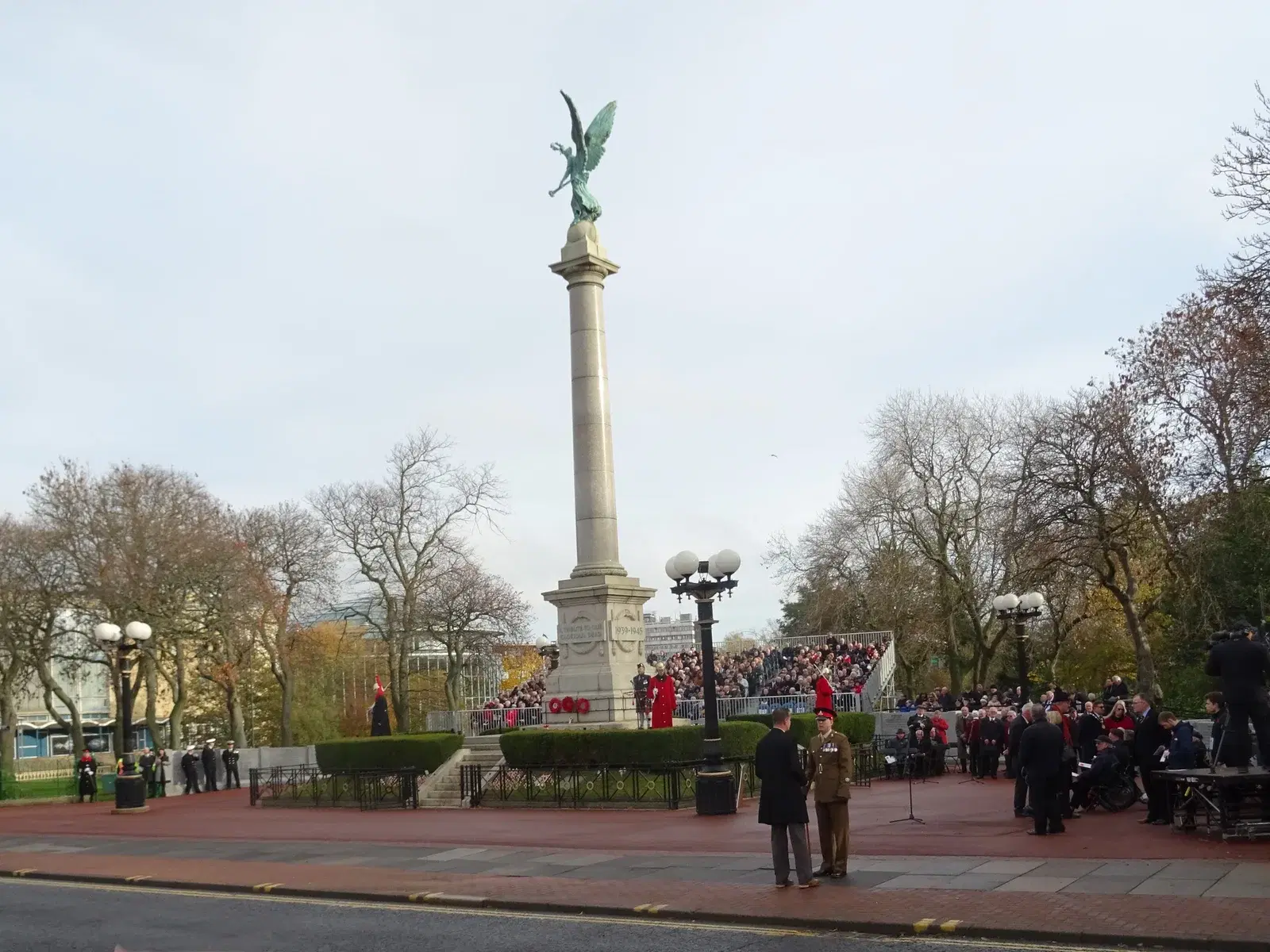
The Sunderland War Memorial stands on Burdon Road, at the edge of Mowbray Park. It was unveiled in about 1925 to the dead of the First World War, and was designed by R.A. Ray, with a bronze Angel of Victory on top of a Tuscan column. It is listed Grade II. The dates 1939 to 1945 were added to its south face after the Second World War. Each year Sunderland's Remembrance Sunday service is held there.
Sunderland Museum and Winter Gardens, beside the memorial, holds local history collections that cover the war years. It closed in August 2026 for a £13.6m refurbishment and is due to reopen in 2028; in the meantime, objects from the collections appear at pop-up displays around the city.
Best for: The War Memorial on Burdon Road is open at all times, and the Remembrance Sunday service is the main public commemoration.
Visiting today
Many of the places in this guide are within a short walk of each other. Start at the War Memorial on Burdon Road, walk through Mowbray Park, then head to Fawcett Street to see where Binns stood and up to Toward Road for the site of the Victoria Hall. Keel Square and the river are about ten minutes further on. Our heritage walking trail covers several of the same places.
For the longer history of the town, read our short history of Sunderland, or browse the heritage hub.
Know a wartime story or site we have missed? Get in touch.
Local businesses mentioned
Never miss what’s on
Join the weekly SunderlandCity.live digest — the best events, news and local tips, straight to your inbox. One email a week.
What's On
Witches, Fairies and Satan: Folk Tales of County Durham
1:00 PM · Arts Centre Washington, Biddick Lane, Fatfield, Washington, NE38 8AB
Frozen Assets
7:30 PM · Arts Centre Washington, Biddick Lane, Fatfield, Washington, NE38 8AB
Spotlight: Washington Open Exhibition 2026
See website · Arts Centre Washington, Biddick Lane, Fatfield, Washington, NE38 8AB