Sunderland Glass and Pottery: From Bede's Windows to Pyrex and Lustreware
How Sunderland became a glassmaking and pottery town: Hartley's plate glass, Jobling's Pyrex, lustreware bridge jugs, the National Glass Centre years and the Glassworks planned for 2028.
Glass and pottery are two of the trades that gave Sunderland its reputation beyond the North East. Our guide to historic trades gives a short overview of both, and the history of Sunderland places them in the city's longer story. This guide looks at the individual works, the families behind them, the objects they made, and where those objects can be found now that the National Glass Centre has closed.
Glass for Bede's monastery
The story begins in 674, when Benedict Biscop founded the monastery of St Peter at Wearmouth. Bede records that Biscop sent to Gaul for glassmakers to glaze the windows of the new church, because the craft was not then practised in England. It is the earliest recorded glassmaking on Wearside, more than a thousand years before the industry took off.
The Victorian glassworks
Glassmaking grew into a major industry on the Wear in the 18th and 19th centuries. By the 1850s the town's bottle works were making between 60,000 and 70,000 bottles a day. Alongside them grew specialist works making plate glass, pressed glass and fine tableware.
James Hartley's Wear Glass Works opened around 1836 at Deptford, on Trimdon Street and Hylton Road. Hartley's firm patented a method of making rolled plate glass in the 1840s, and by the middle of the century it was producing about a third of all the plate glass made in Britain. When the Crystal Palace went up in Hyde Park for the Great Exhibition of 1851, Hartley's supplied a large share of its glass. The business declined in the 1880s and a sale was ordered by the Court of Chancery in 1892.
The name lived on. In 1895 James Hartley junior and Alfred Wood formed Hartley Wood and Co, which became known for antique coloured glass used in stained glass windows, including the Ascension window at Hexham Abbey. Pilkington bought the firm in 1982, and the works closed for good in November 1997.
Pressed glass was another Sunderland speciality. The Cornhill Flint Glassworks at Southwick opened in 1865 and made pressed glass. On Trimdon Street, Nicholas French set up the Wear Flint Glassworks in 1852. Henry Greener and James Angus bought it in 1858, and in 1873 Greener built a new glasshouse at Millfield.
Jobling and Pyrex
The Millfield works passed to James Augustus Jobling, a Newcastle merchant. In 1922 his firm took the British licence from the American company Corning to make Pyrex, heat-resistant glass that could go from oven to table. Production of Pyrex in Sunderland continued until 31 March 2007.
Sunderland lustreware
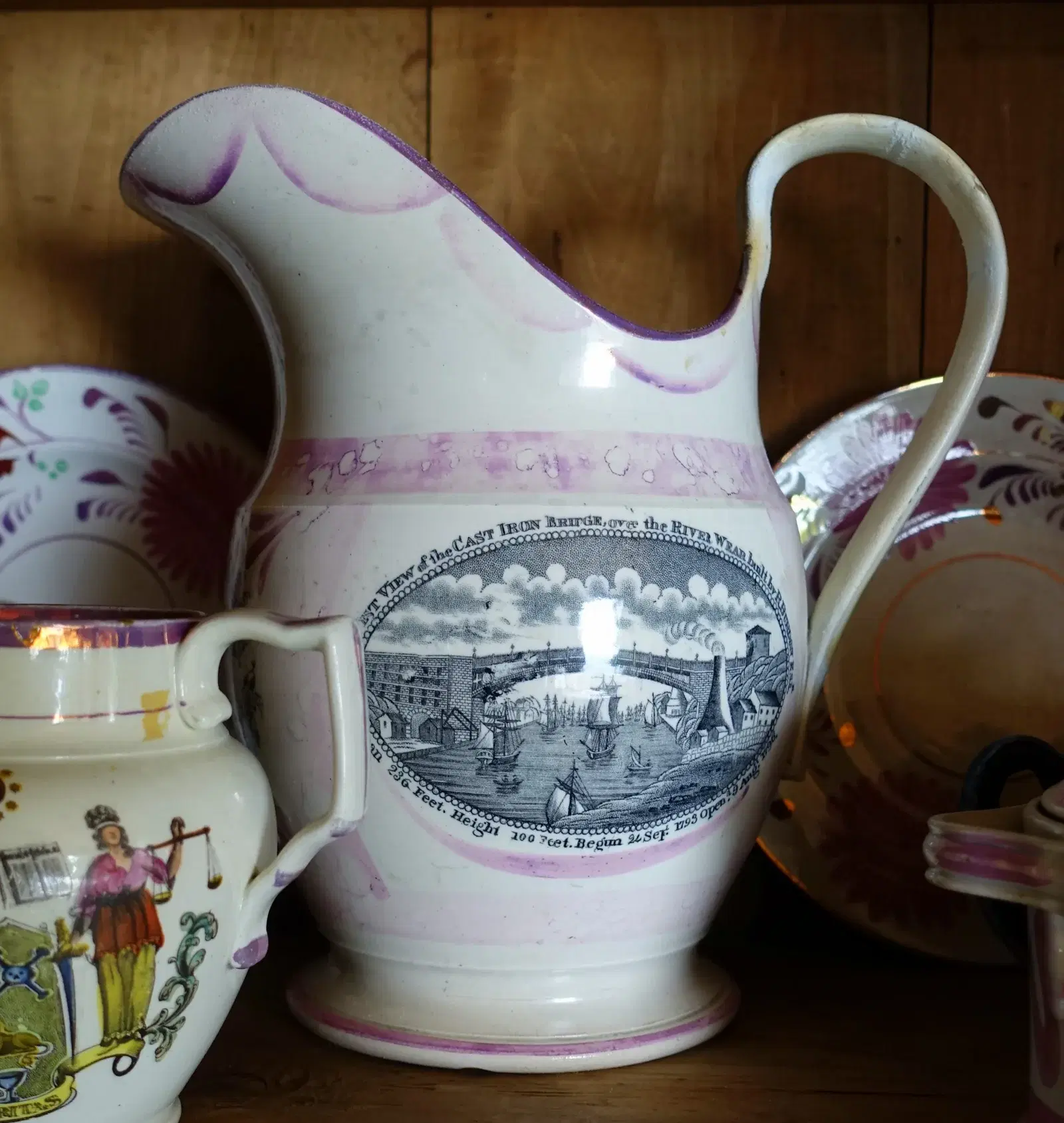
Sunderland's potteries are best remembered for lustreware, earthenware decorated with a thin metallic glaze. Pink lustre was developed by Wedgwood around 1805, and most Sunderland lustreware dates from the early 19th century.
Several potteries worked on the Wear, including the Garrison Pottery (the town's first commercial pottery), Scott's at Southwick and Dawson's at Low Ford, now South Hylton. A clock chimneypiece made by Dixon, Austin and Co between 1820 and 1826 shows how ambitious their work could be. A popular technique was splash lustre, where drops of oil were spattered over the glaze before firing to give a mottled pink finish.
The decoration often told a local story. Transfer prints showed ships, Masonic emblems and, most famously, the cast iron Wearmouth Bridge. The jug at the top of this page carries a view of the bridge with the inscription recording that it was begun on 24 September 1793, with a span of 236 feet and a height of 100 feet. Many pieces carried verses, the best known being "May Peace and Plenty on our Nation Smile, and Trade with Commerce Bless the British Isle".
The National Glass Centre, 1998 to 2026
For almost three decades the city's glass heritage had a home on the north bank of the Wear. The National Glass Centre opened in 1998 on the former J.L. Thompson shipyard site at North Sands. Built of glass and steel at a cost of about £17 million, it had a roof containing 3,250 square metres of glass and combined exhibition galleries with glassmaking studios.
The university took over the building in 2013. The National Glass Centre closed permanently on 31 July 2026. The university planned to demolish the building, saying repairs would cost between £14 million and £45 million, while campaigners sought to have it listed. Check local news for the latest on the building's future.
Glassworks: the next chapter
Glassmaking is due to continue in the city through Glassworks: Sunderland, a new maker space planned to open in 2028 in a former antiques warehouse on Borough Road in Sunniside. It is led by Sunderland Culture with the V&A, Sunderland City Council and the University of Sunderland, and is backed by a £5 million grant from the Department for Culture, Media and Sport towards a project of about £7.5 million. It is planned as a working space for glassmaking rather than a museum.
See it today
A comprehensive collection of Sunderland lustreware belongs to Sunderland Museum and Winter Gardens, which is closed for redevelopment until 2028. While it is closed, some objects appear at pop-up displays around the city.
Best for: Sunderland Culture's website lists any pop-up displays of the city's collections, and the Culture House on Keel Square is a good place to ask.
Hartley Wood glass can still be seen in the Ascension window at Hexham Abbey, and Sunderland-made Pyrex, pressed glass and lustreware regularly turn up in antique shops and at auction. For family history in the glass and pottery trades, the Sunderland Antiquarian Society archive is the place to start. Our local museums guide lists what is open while the main museum is closed, and our interesting facts about Sunderland has more on the city's past.
Know a place we have missed? Get in touch.
Never miss what’s on
Join the weekly SunderlandCity.live digest — the best events, news and local tips, straight to your inbox. One email a week.
What's On
Witches, Fairies and Satan: Folk Tales of County Durham
1:00 PM · Arts Centre Washington, Biddick Lane, Fatfield, Washington, NE38 8AB
Frozen Assets
7:30 PM · Arts Centre Washington, Biddick Lane, Fatfield, Washington, NE38 8AB
Spotlight: Washington Open Exhibition 2026
See website · Arts Centre Washington, Biddick Lane, Fatfield, Washington, NE38 8AB