18 Interesting Facts About Sunderland
Eighteen checked facts about Sunderland, from Bede and a 7th-century glass workshop to the push-bar door, the Wearmouth Bridge, Roker lighthouse and the Stadium of Light.
Sunderland is a young city with a long past. It only gained city status in 1992, but people have been building ships, making glass and exporting coal at the mouth of the Wear for centuries. These eighteen facts have been checked against published sources, and each one points to somewhere you can go and see for yourself. For the full story, read our history of Sunderland.
Saints, monks and glass
1. Bede was born here. The Venerable Bede, often called the father of English history, was born at Wearmouth in 673 and entered the monastery as a boy.
2. The monastery was one of the first stone buildings in Northumbria. Benedict Biscop founded St Peter's at Monkwearmouth in 674. The west wall and porch of the original church still stand, and the building is Grade I listed.
3. Stained glass returned to Britain on the Wear. Biscop brought glassworkers over from Gaul to glaze his church, which is why Sunderland is often credited with reintroducing glassmaking to Britain.
4. Benedict Biscop is the city's patron saint. The city formally adopted him on 24 March 2004.
Best for: St Peter's Church suits anyone with an hour to spare near the university's riverside campus.
Ships, coal and bridges
5. Ships have been built on the Wear since at least 1346. By 1850 the local paper was calling Sunderland the greatest shipbuilding port in the world, and between 1846 and 1854 almost a third of the UK's ships were built here. The last yards closed in 1988.
6. The first Wearmouth Bridge was the world's second iron bridge. It opened in 1796 and, with a single 236-foot span, was the longest single-span bridge in the world at the time. The current steel bridge was opened on 31 October 1929.
7. The world's first steam dredger worked the river. It was built in Sunderland in 1796-7 and put to work on the Wear the following year.
8. The world's first patent ropery still stands. In 1797 Sunderland gained the world's first patent ropery, which spun hemp by machine instead of along a traditional ropewalk. The building still stands. Our guide to historic trades in Sunderland has more on the town's industries.
Disaster and reform
9. A Sunderland tragedy changed building law. On 16 June 1883, 183 children died in a crush at the Victoria Hall during a children's show. The door at the foot of the stairs opened inward and had been bolted. The disaster led to laws requiring public buildings to have outward-opening exits and helped bring about the push-bar emergency door. A memorial stands in Mowbray Park.
10. Sunderland was bombed in both world wars. A Zeppelin raid struck Monkwearmouth on 1 April 1916, killing 22 people, and Luftwaffe raids in the Second World War killed 267 people.
The coast
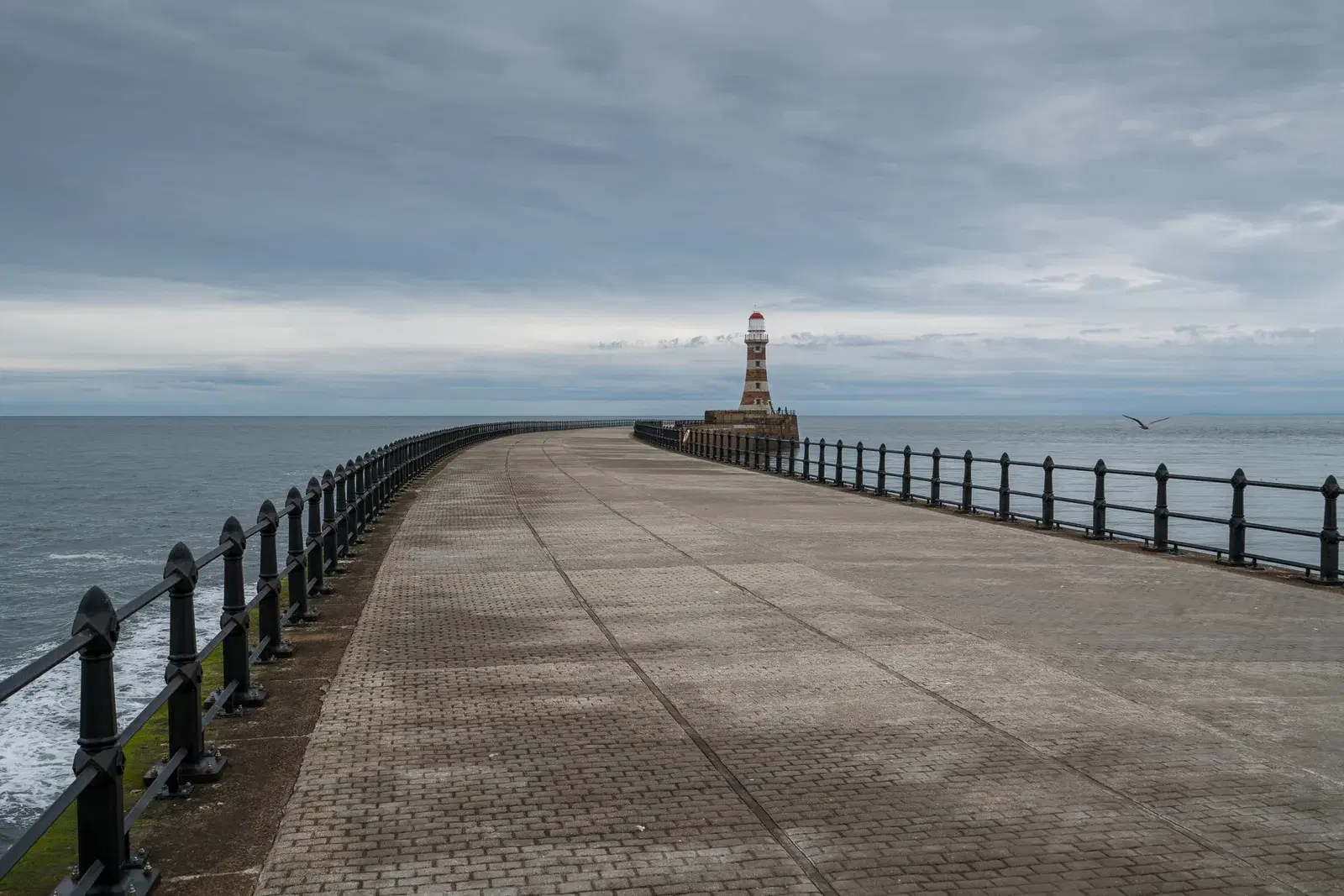
11. Roker lighthouse was built of red and white granite. Roker Pier, started in 1885, is 1,198 feet long. Its lighthouse was completed in 1903 from red and white Aberdeen granite. The older lighthouse from the South Pier was moved to Roker Cliff Park, where it still stands.
12. L. S. Lowry painted Wearside. The Salford painter often stayed at the Seaburn Hotel, and many of his seascapes and shipbuilding scenes were based on Sunderland views. See our Roker and Seaburn seafront guide.
Best for: The pier and lighthouse suit a calm walk on a dry day, in any season.
Hills, castles and engines
13. Penshaw Monument is a copy of a Greek temple. Built in 1844-45 in memory of John Lambton, 1st Earl of Durham, Penshaw Monument is modelled on the Temple of Hephaestus in Athens. It appears on Sunderland AFC's crest, alongside the Wearmouth Bridge.
14. Hylton Castle is around 600 years old. Sir William Hylton built the stone gatehouse-tower around 1400, and its west front is still covered in medieval heraldry. Hylton Castle was restored with lottery and council funding from 2016 and now operates as a community and visitor centre.
15. Ryhope's engines pumped water for a century. The Victorian pumping station at Ryhope ran from the 1860s until 1967. Volunteers at Ryhope Engines Museum still put the beam engines into steam on some open days.
16. George Washington's ancestors lived in Washington. Washington Old Hall was the home of the de Wessyngton family from the 12th century. It was saved from demolition in 1936 and has been run by the National Trust since 1957.
Best for: Penshaw and Washington Old Hall suit a half-day trip by car or bus from the city centre.
Football and the word Mackem
17. The Stadium of Light stands on a coal mine. The Stadium of Light opened in 1997 on the site of Monkwearmouth Colliery, which closed in 1993. A Davy lamp monument outside the ground honours the miners, and the name refers to the same lamps. Sunderland AFC itself was founded in 1879 by a schoolmaster, James Allan.
18. Nobody is sure where "Mackem" comes from. The nickname for people from Sunderland has been in common use since the 1970s and 1980s. One popular explanation links it to shipbuilders who would "mak 'em and tak 'em", but its origin is still disputed.
Bonus: the Empire
The Sunderland Empire on High Street West opened on 1 July 1907 with the music-hall star Vesta Tilley. The Beatles played there on their first UK national tour, and with 1,860 seats it is one of the largest venues in the North East.
Where to go next
Several of these places can be combined in a single day. Our things to do in Sunderland and free things to do in Sunderland guides help with planning, and the heritage hub collects the rest of our history guides.
Know a place we have missed? Get in touch.
Local businesses mentioned
Penshaw Monument
Chester Road, Penshaw, Sunderland, DH4 7NJ
Hylton Castle
Craigavon Road, Castletown, Sunderland, SR5 3PA
Ryhope Engines Museum
Waterworks Road, Ryhope, Sunderland, SR2 0ND
Washington Old Hall
The Avenue, Washington Village, Washington, NE38 7LE
Sunderland AFC (Stadium of Light)
Stadium of Light, Millennium Way, Monkwearmouth, Sunderland, SR5 1SU
Sunderland Empire
4-5 High Street West, Sunderland, SR1 3EX
Never miss what’s on
Join the weekly SunderlandCity.live digest — the best events, news and local tips, straight to your inbox. One email a week.
What's On
Witches, Fairies and Satan: Folk Tales of County Durham
1:00 PM · Arts Centre Washington, Biddick Lane, Fatfield, Washington, NE38 8AB
Frozen Assets
7:30 PM · Arts Centre Washington, Biddick Lane, Fatfield, Washington, NE38 8AB
Spotlight: Washington Open Exhibition 2026
See website · Arts Centre Washington, Biddick Lane, Fatfield, Washington, NE38 8AB