The Bridges of Sunderland: Crossing the Wear
A heritage guide to the bridges over the Wear in Sunderland, from the Wearmouth Bridge and the 1879 railway bridge to the Queen Alexandra Bridge, Northern Spire and Keel Crossing.
Sunderland grew up on both banks of a deep river gorge, and for most of its history getting from one side to the other meant a ferry. The bridges that now cross the Wear were each built to solve a particular problem: coal that needed to reach the docks, trains that needed a direct line to Newcastle, traffic that needed a way around the city centre, and, most recently, football crowds that needed a safer walk to the match. Taken in order from the sea upstream, they make a short history of the city. Our history of Sunderland covers the city's growth; this guide looks at the crossings themselves.
Wearmouth Bridge
The bridge closest to the sea is the Wearmouth Bridge, which carries the main road north from the city centre to Monkwearmouth. The first bridge on this site was a cast-iron arch designed by Rowland Burdon, based on an idea by Thomas Paine, and opened in 1796. At the time it was the largest single-span bridge in the world. It was repaired in 1805 and reconstructed by Robert Stephenson between 1857 and 1859.
The present steel arch was begun in 1927 to a design by the engineers Mott, Hay and Anderson, and its steelwork was made by Sir William Arrol and Company at Dalmarnock in Glasgow. It was built around the old bridge so that the road could stay open during the work. The Duke of York opened it on 31 October 1929, and it cost £231,943. It is Grade II listed, and since a 1997 redesign its outline has appeared on the Sunderland AFC crest alongside Penshaw Monument.
Monkwearmouth Railway Bridge
Just upstream, and so close that the two are often photographed together, is the railway bridge. It was built in 1879 for the Monkwearmouth Junction line, which gave Sunderland its first direct railway link with Newcastle. The engineer was T. E. Harrison. Its iron bowstring truss has a main span of 300 feet, sits 86 feet above high water, and was claimed at the time as the largest hogsback iron bridge in the world.
The bridge was Grade II listed in 1978. Since 2002 it has carried Tyne and Wear Metro trains as well as main-line services, and it was strengthened in 2007. St Peter's Metro station sits on its northern approach, a short walk from St Peter's Church.
Keel Crossing
The newest crossing is the Keel Crossing, a high-level steel footbridge for pedestrians and cyclists. It runs from Keel Square in the city centre to the Sheepfolds side of the river and the Stadium of Light, and was commissioned partly to take matchday crowds off the Wearmouth Bridge. The name was chosen by public vote and announced on 11 June 2025.
The bridge opened for a single day on 22 August 2025 for the opening match of the Women's Rugby World Cup at the Stadium of Light, and opened permanently on 18 October 2025. It is about 260 metres long, stands roughly 30 metres above the river and cost around £31 million. VolkerStevin built it, with the steelwork fabricated by Victor Buyck in Ghent.
Queen Alexandra Bridge
Further upstream, the Queen Alexandra Bridge links Deptford on the south bank with Southwick on the north. Before it was built, people crossed here by ferry. It was designed by Charles A. Harrison and built by Sir William Arrol and Company between 1907 and 1909; the two halves met on 15 October 1908. The Earl of Durham opened it on 10 June 1909 on behalf of Queen Alexandra.
The bridge was built in two decks. It was agreed in 1899 between the North Eastern Railway and Sunderland Corporation, partly to connect the coalfields around Annfield Plain and Washington with the south docks. The lower deck carries the road, and the upper deck carried the railway. It has a 300-foot main span with 85 feet of clearance, was the heaviest bridge in the UK when it opened, and cost £450,000. Around six million tonnes of coal a year crossed the upper deck for export, but the trade fell away at the end of the 1910s and the last goods train ran in 1921. In the Second World War the empty upper deck was used for searchlights and anti-aircraft guns. The railway and the decking at each end were removed late in the 20th century, and repairs in 2005 and 2006 cost £6.3 million.
Northern Spire
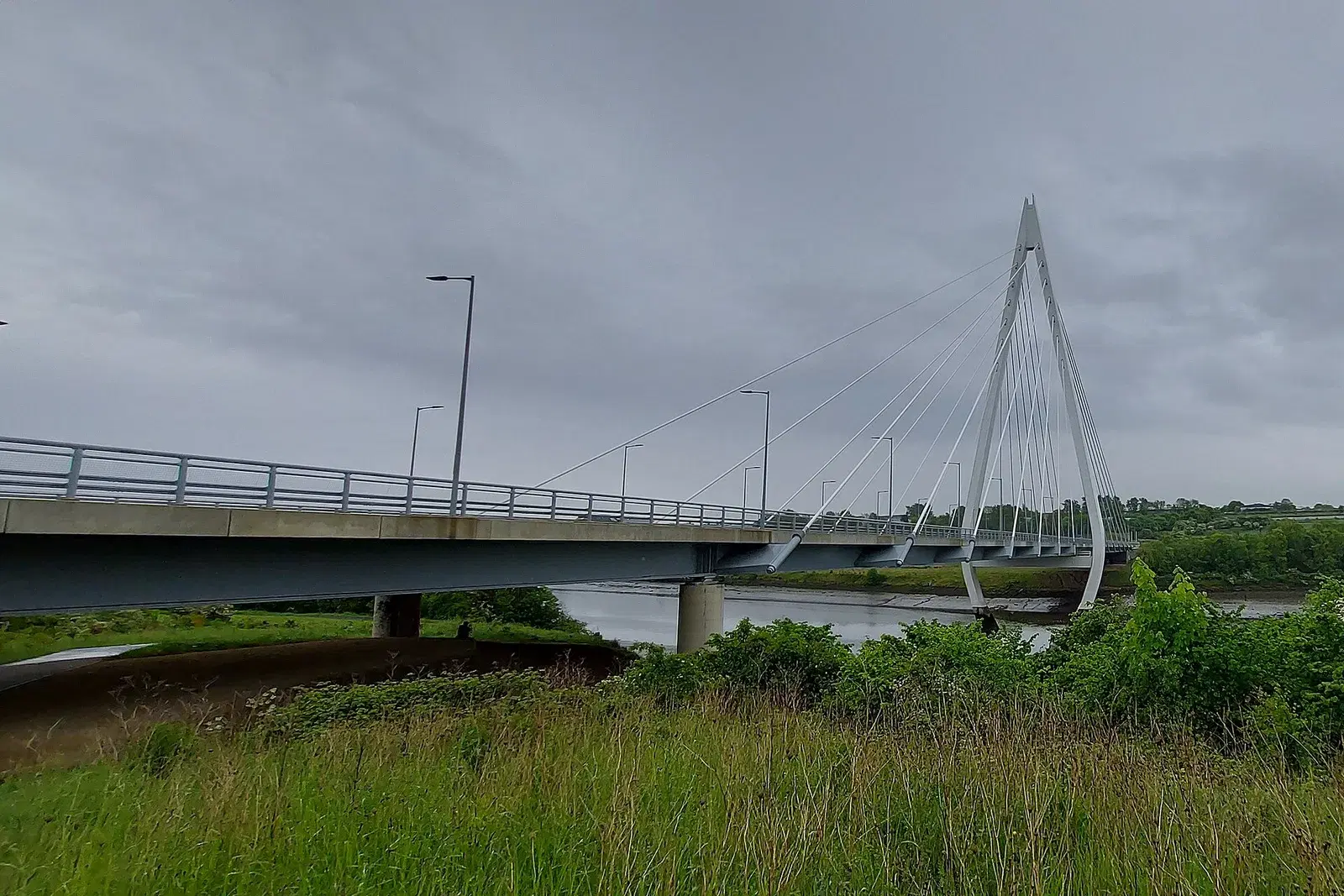
Between the Queen Alexandra Bridge and the A19 is the Northern Spire, a two-span cable-stayed road bridge. Work began in May 2015, with Farrans and Victor Buyck as contractors. Its 105-metre steel pylon, the tallest structure in Sunderland, was lifted into place on 10 and 11 February 2017. The name was chosen in a public vote the same year. The bridge opened to pedestrians on 28 August 2018 and to traffic the next day.
The bridge had a long gestation. A 2005 design competition run by Sunderland Arc drew entries including one from Frank Gehry, and a more ambitious design by Spence Associates became council policy in 2009. Several contractors withdrew because it could not be built for the approved budget, and in 2014 the project switched to the simpler cable-stayed design that was built.
Hylton Viaduct
The A19 crosses the Wear on the Hylton Viaduct, a steel box-girder bridge between North Hylton and South Hylton. It was opened in 1974 by Jean Temple, a shorthand typist and secretary. Below it ran a chain ferry, which stopped operating in 1915. Hylton Castle, on the north side of the river, is a short drive away.
Victoria Viaduct
Beyond the city's built-up area, near Penshaw and Washington, the Victoria Viaduct carried the Durham Junction Railway over the Wear. James Walker designed it, with T. E. Harrison overseeing the work, and its arches were modelled on the Roman bridge at Alcántara in Spain. Construction ran from 17 March 1836 to 28 June 1838, the day of Queen Victoria's coronation, which gave the viaduct its name. It is built of local Penshaw sandstone and is about 247 metres long.
The viaduct is Grade II* listed but has not carried trains since 1991. It features in proposals for a Metro extension to Washington. Penshaw Monument is close by; see our Penshaw Monument and Herrington Country Park guide.
See it today
The city-centre bridges are easiest to take in on foot. From Keel Square you can cross the Keel Crossing to the Sheepfolds side, head downstream to the Wearmouth Bridge and walk back across it to the city centre, with the railway bridge alongside. Sheepfolds Stables is on the north bank, the Stadium of Light is a few minutes' walk, and the Keel Tavern is back in Keel Square.
Best for: On matchdays the Keel Crossing and the Wearmouth Bridge are busy before and after kick-off, so pick a non-match day for an unhurried look at the bridges.
The Queen Alexandra Bridge and the Northern Spire can both be crossed on foot. Our best walks in Sunderland guide has more routes along the river.
Know a place we have missed? Get in touch.
Local businesses mentioned
Keel Tavern
Unit 2, Holiday Inn, Keel Square, Sunderland, SR1 3DS
Sunderland AFC (Stadium of Light)
Stadium of Light, Millennium Way, Monkwearmouth, Sunderland, SR5 1SU
Sheepfolds Stables
Easington Street, Sheepfolds, Sunderland, SR5 1BA
Hylton Castle
Craigavon Road, Castletown, Sunderland, SR5 3PA
Penshaw Monument
Chester Road, Penshaw, Sunderland, DH4 7NJ
Never miss what’s on
Join the weekly SunderlandCity.live digest — the best events, news and local tips, straight to your inbox. One email a week.
What's On
Witches, Fairies and Satan: Folk Tales of County Durham
1:00 PM · Arts Centre Washington, Biddick Lane, Fatfield, Washington, NE38 8AB
Frozen Assets
7:30 PM · Arts Centre Washington, Biddick Lane, Fatfield, Washington, NE38 8AB
Spotlight: Washington Open Exhibition 2026
See website · Arts Centre Washington, Biddick Lane, Fatfield, Washington, NE38 8AB