Coal Mining in Sunderland: Pits, Railways and the Miners' Legacy
Sunderland's coal mining story, from the Hetton Colliery Railway and the deep Monkwearmouth pit to Ryhope, Silksworth, Herrington and the Washington F Pit, with the memorials you can visit today.
For more than three centuries coal was the trade that kept the port of Sunderland busy. Our guide to historic trades covers the early coal trade and the keelmen who carried it downriver, and the history of Sunderland sets out the wider timeline. This guide goes underground: the pits that were sunk within today's city boundary, the railway built to carry their coal, the communities that grew up around them, and the places where you can still see their mark.
Shipping the coal
By the 19th century the coal trade had grown far beyond what the keelmen could handle, and by 1889 about two million tons of coal a year were passing through Hudson Dock alone. Getting the coal from the pits to the river was the problem, and Sunderland.s answer to it was a pioneering railway.
The Hetton Colliery Railway
The Hetton Colliery Railway opened on 18 November 1822. It was designed by George Stephenson, with his son Robert as resident engineer, and ran for about eight miles from Hetton Colliery to staithes on the Wear at Sunderland, where coal was tipped into waiting ships.
It was the first railway designed from the start to run without any animal power at all. Over the steepest ground, around Warden Law, wagons were hauled by stationary steam engines. Elsewhere there were five self-acting inclines, where the weight of full wagons running downhill pulled the empty ones back up.
The line carried coal for well over a century and closed on 12 September 1959. Parts of its trackbed are now the Stephenson Trail, a walking and cycling route.
Monkwearmouth Colliery
The pit most closely tied to the city itself was Monkwearmouth Colliery, also known as Wearmouth Colliery or Pemberton Main, on the north bank of the river. Sinking began in 1826 and took until 1834, reaching a depth of 1,578 feet. When it began producing coal in 1835 it was the deepest mine in the world.
The colliery worked for more than 150 years. Its last shift ended on 10 December 1993. Until the site was cleared it still had two horizontal winding engine houses and a heapstead. The Stadium of Light, home of Sunderland AFC, opened on the site in July 1997, and the sculptures around it remember what was there before.
The pit villages
Coal mining spread across the land that now makes up the City of Sunderland, and many of its outer districts began as colliery villages.
Ryhope Colliery opened in 1859 and closed in 1966. A pit pony statue was put up in the village in 2009 as a memorial to the mine; it was stolen in 2021, and a second pony statue was stolen in 2024.
Silksworth Colliery was sunk in 1869 by the Londonderry family's mining company and closed in 1971. The colliery site is now the Silksworth Sports Complex and ski slope.
Herrington Colliery worked from 1874 to 1985. Reclamation of the site began in 1996, and the land is now Herrington Country Park, below Penshaw Monument. Our Penshaw Monument and Herrington Country Park guide covers a visit.
The Washington F Pit
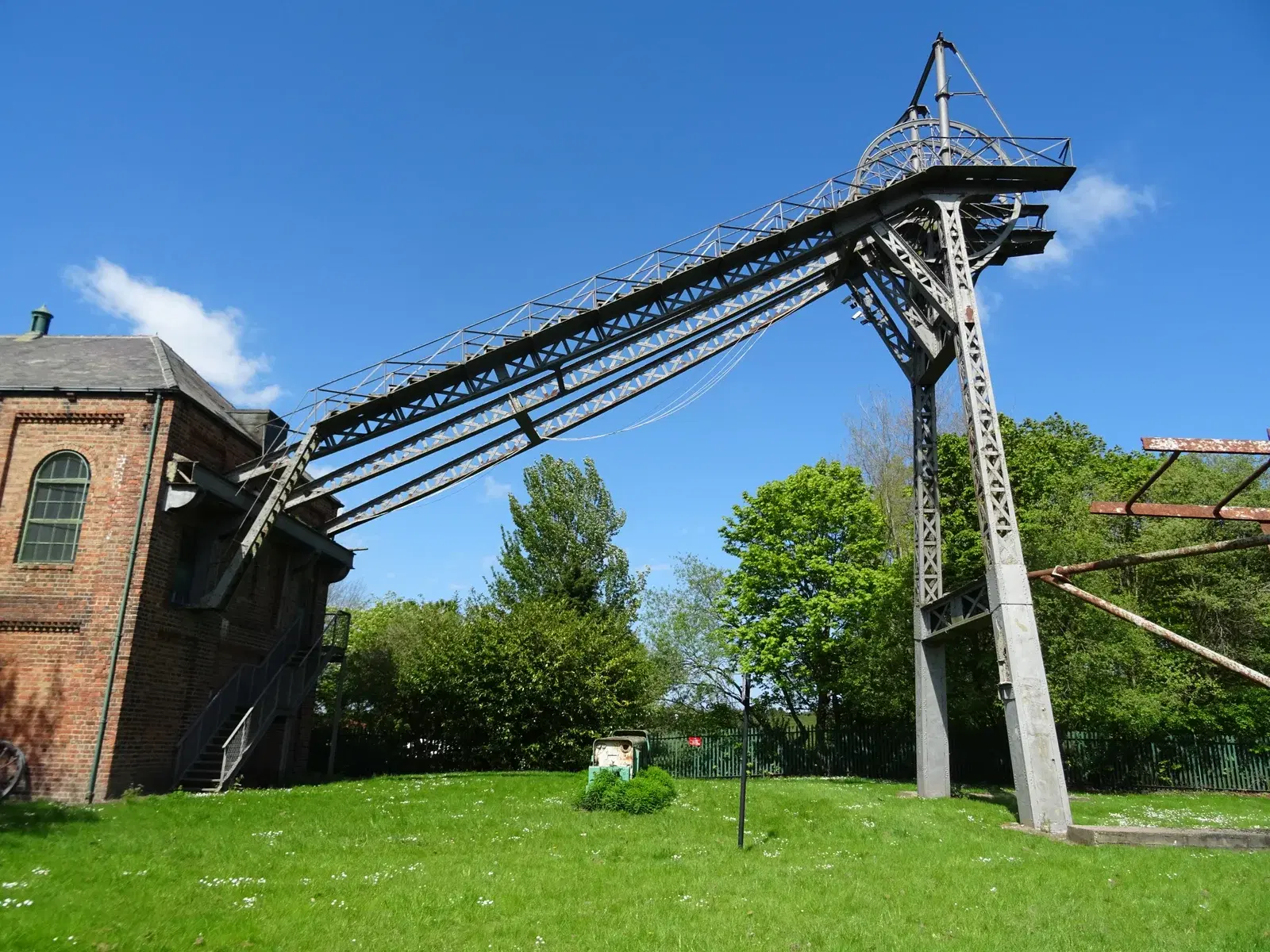
In Washington, the F Pit keeps its engine house and winding gear. Its shaft was sunk in 1777 and eventually reached 283 metres. The engine house dates from 1903 and contains a horizontal twin-cylinder steam winding engine built in 1888 by the Grange Iron Company. The pit closed on 21 June 1968, and the National Coal Board presented the engine house and winding gear to the people of Washington. Both are protected, as a scheduled monument and a Grade II listed building.
The site has traditionally opened to visitors on a seasonal basis. A regeneration scheme worth about £4.6 million, with a new heritage visitor centre and café, has been planned with an opening aimed at summer 2027. Check the current arrangements before making a special trip. Washington Old Hall and the North East Land, Sea and Air Museums are also in Washington if you want to combine a visit.
Lamps, banners and the Gala
The danger of gas underground shaped every mining community, and the safety lamp is one of the most familiar symbols of the industry. In Sunderland it is remembered in a four-metre Davy lamp sculpture by the Fulwell sculptor Jim Roberts, which stands by the stadium entrance off Southwick Road. The light inside it is never put out.
Each pit had its union lodge, and each lodge had its banner. The Durham Miners' Gala, first held in 1871 in Wharton Park in Durham, brings those banners together on the second Saturday in July, each one marched through the city behind a brass band. Many banners are still paraded every year, long after the pits closed.
Best for: The Davy lamp, the pit cap and the Men of Steel sculpture are all within a few minutes' walk of each other around the Stadium of Light, so they suit a short stop before a match or on a riverside walk.
See it today
Around the Stadium of Light, the western section of the riverside sculpture trail is given over to mining. As well as the Davy lamp, look for:
- Men of Steel, by Graeme Hopper, showing figures pushing coal
- a bronze pit cap marking the site of Wearmouth Colliery
- a column of pick handles, rope, lamps and bait boxes that marks the Brockwell Bottom seam
The Colliery Tavern on Southwick Road, opposite the stadium, keeps the pit's name. Further out, Herrington Country Park, Silksworth and the Stephenson Trail all sit on former mining land, and the F Pit in Washington is the place to see a real winding engine house. For more on the club that now plays on the pit site, the Fans Museum is close by.
Sunderland Museum and Winter Gardens is closed for redevelopment until 2028. Our local museums guide lists what is open in the meantime, and our best walks in Sunderland guide has more routes to explore.
Know a place we have missed? Get in touch.
Local businesses mentioned
Sunderland AFC (Stadium of Light)
Stadium of Light, Millennium Way, Monkwearmouth, Sunderland, SR5 1SU
Colliery Tavern
12 Southwick Road, Monkwearmouth, Sunderland, SR5 1EQ
Silksworth Sports Complex & Ski Slope
Silksworth Lane, Silksworth, Sunderland, SR3 1PD
Penshaw Monument
Chester Road, Penshaw, Sunderland, DH4 7NJ
Washington Old Hall
The Avenue, Washington Village, Washington, NE38 7LE
Never miss what’s on
Join the weekly SunderlandCity.live digest — the best events, news and local tips, straight to your inbox. One email a week.
What's On
Witches, Fairies and Satan: Folk Tales of County Durham
1:00 PM · Arts Centre Washington, Biddick Lane, Fatfield, Washington, NE38 8AB
Frozen Assets
7:30 PM · Arts Centre Washington, Biddick Lane, Fatfield, Washington, NE38 8AB
Spotlight: Washington Open Exhibition 2026
See website · Arts Centre Washington, Biddick Lane, Fatfield, Washington, NE38 8AB