Shipbuilding on the Wear: The Yards, the Liberty Ship and the SD14
The story of Sunderland's shipyards, from Thomas Menville in 1346 to Thompson's Liberty ship design, the SD14 and the 1988 closure, with where to see the river's shipbuilding past today.
Sunderland built ships for more than six centuries, and for long stretches of the 19th and 20th centuries the Wear was one of the busiest shipbuilding rivers in the world. Our guide to historic trades gives the headline numbers and the history of Sunderland sets the wider scene. This guide looks more closely at the yards themselves, the people who ran them, the two ship designs that carried Sunderland's name around the world, and the places along the river where that story can still be traced.
The first shipbuilders
The earliest recorded shipbuilder on the Wear is Thomas Menville, a merchant who was building ships at Wearmouth from 1346. For several centuries after that the work was small in scale: wooden vessels built on open river banks, mostly for the coal trade that kept the port busy.
By the 19th century the river was lined with yards. Some builders became well known in their own right. William Pile built more than 100 wooden ships and almost as many iron ones, a career that spans the change from timber to metal hulls that reshaped the industry.
The family yards
Much of the Wear's output came from family firms that lasted for generations.
J.L. Thompson and Sons was founded in 1846 by Robert Thompson and his sons. Its first ship, the brig Pearl, was built in 11 weeks. The business took the name Joseph L. Thompson in 1870 and became a limited company in 1894. In 1883 it built more tonnage than any other yard on the Wear, launching 16 ships totalling 30,495 tons. Its North Sands site is now home to the University of Sunderland's riverside campus.
Laing traces its start to 1818, when Philip Laing opened a yard at Deptford, upriver from the town centre. It became Sir James Laing and Sons in 1898.
Doxford was founded in 1840 by William Doxford and moved to Pallion in 1870. As well as ships, the firm made marine diesel engines that were fitted to vessels far beyond Sunderland. The last Doxford engine was built around 1980.
Other family firms, among them Short Brothers and Bartram, also built on the Wear, and many smaller yards came and went.
Slump and the road to the Liberty ship
The years after the First World War were hard. The number of shipyards on the Wear fell from 15 in 1921 to six by 1937, and J.L. Thompson launched no ships at all between 1931 and 1934.
When orders returned, Thompson's produced a design that would matter far beyond the river. The Embassage, a 9,100 deadweight ton cargo ship completed in 1935, became the prototype for a family of simple, robust tramp steamers. In late 1940, with Britain short of ships, Robert Cyril Thompson led the British Merchant Shipbuilding Mission to the United States. His firm's design became the basis for the Ocean ships built in American yards for Britain, and in 1941 the American naval architects Gibbs and Cox adapted it into the Liberty ship, which was then built in very large numbers.
At home, Thompson's built 40 ships of 277,697 gross tons during the Second World War. The yard was bombed in May 1943, and an expansion yard at Southwick was launching ships from August that year.
Mergers and the covered yard
After the war, the old family names began to combine. In 1954 Laing and Thompson came together as the Sunderland Shipbuilding, Dry Dock and Engineering Company. In the same year S.P. Austin and Son and William Pickersgill and Sons merged to form Austin and Pickersgill, based at Southwick. Laing and Thompson joined Doxford in the 1960s, and the full merger in 1966 created Doxford and Sunderland.
In 1972 Court Line took over the Doxford and Sunderland yards as Sunderland Shipbuilders Ltd. Its new all-weather yard at Pallion was designed so that two ships of up to 30,000 deadweight tons could be built side by side under cover. Court Line collapsed in 1974 and the yards passed into public ownership, and in 1977 the river's builders became part of the nationalised British Shipbuilders.
The SD14
Austin and Pickersgill's best-known product grew out of the same problem the Liberty ship had solved: by the 1960s, the wartime cargo ships still trading around the world were wearing out. Development of a replacement began in 1965. The result was the SD14, a standard cargo ship design that owners could order without commissioning a new design from scratch.
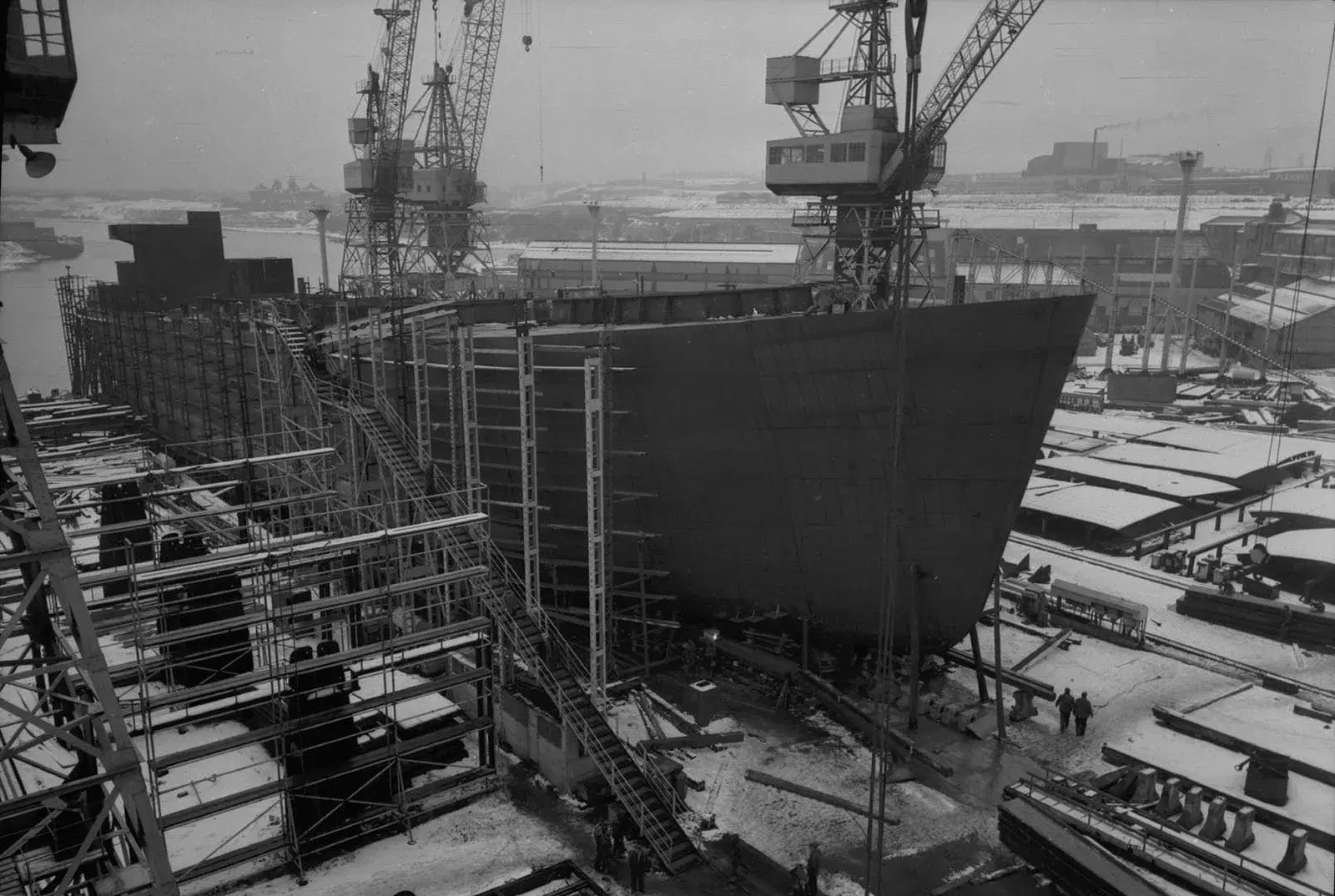
The first SD14, the Nicola, was under construction at Southwick in the winter of 1967 (she is the ship in the photograph at the top of this page) and was handed over in February 1968. In all, 211 SD14s were built, some in Sunderland and others under licence by yards in Greece, Brazil, Scotland and Argentina.
The end of shipbuilding on the Wear
In 1986 Austin and Pickersgill merged with Sunderland Shipbuilders to form North East Shipbuilders. Two years later, after negotiations between the government and the European Commission, the Southwick and Pallion yards closed in 1988, and the last vessel was floated out at Pallion in 1989. The Pallion site is now used by Pallion Engineering, and much of the riverbank where the yards stood has since been redeveloped, including the university campus at North Sands.
See it today
Most of the yards have gone, but the river still carries plenty of reminders.
Keel Square in the city centre has the Keel Line, a strip of paving the length of the Naess Crusader, the largest ship launched on the Wear. Along it are the names of more than 8,100 ships built on the river, with illustrations by Bryan Talbot. The Propellers of the City sculpture by Stephen Broadbent, which carries the names of shipyard workers, marks the start of the line; it was damaged in December 2021 and removed for repair, so check whether it is back in place before you make a special trip. The Culture House, which opened on Keel Square in September 2026, and the Keel Tavern are both close by.
The Keel Crossing, which opened on 18 October 2025, takes its name from the keel and continues the Keel Line theme across the river.
On the north bank, the riverside sculpture trail between the university and the harbour has an eastern section given over to shipbuilding. Close to North Dock stands Molly, a life-size steel figure by Dr Ron Lawson, unveiled in January 2025 in honour of the women who worked in Sunderland's shipyards.
Sunderland Maritime Heritage, a volunteer-run charity on Church Street East in the East End, holds models, photographs and records of the river's shipbuilding past. It is also restoring vessels including the Willdora, a 1901 fishing boat that took part in the Dunkirk evacuation, and the former pilot boat Wearmouth.
Best for: Sunderland Maritime Heritage usually opens on Monday, Wednesday and Friday mornings, and its guided tours are best booked ahead through its website.
If your family worked in the yards, the Sunderland Antiquarian Society archive is a good place to begin research. For a walking route that takes in the riverbanks, see our heritage walking trail, and for the wider picture of what has been lost, our guide to lost buildings of Sunderland.
Know a place we have missed? Get in touch.
Local businesses mentioned
Never miss what’s on
Join the weekly SunderlandCity.live digest — the best events, news and local tips, straight to your inbox. One email a week.
What's On
Witches, Fairies and Satan: Folk Tales of County Durham
1:00 PM · Arts Centre Washington, Biddick Lane, Fatfield, Washington, NE38 8AB
Frozen Assets
7:30 PM · Arts Centre Washington, Biddick Lane, Fatfield, Washington, NE38 8AB
Spotlight: Washington Open Exhibition 2026
See website · Arts Centre Washington, Biddick Lane, Fatfield, Washington, NE38 8AB